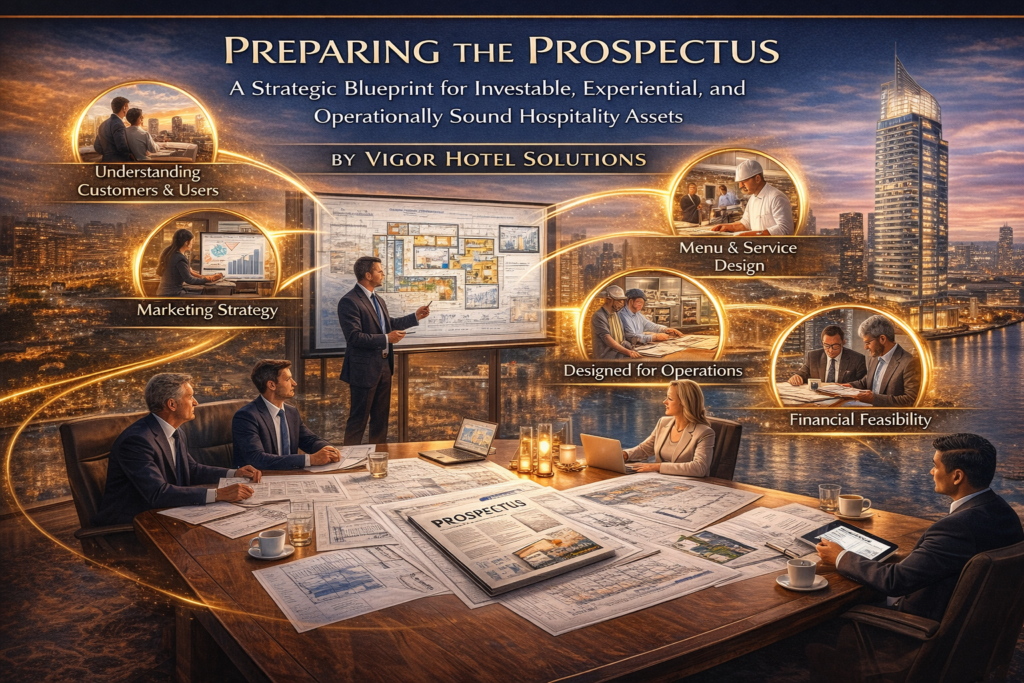
A Strategic Blueprint for Creating Investable, Experiential, and Operationally Sound Hospitality Assets
By Charles Tan, Vigor Hotel Solutions
Introduction: Why the Prospectus Is More Than a Document
In hospitality development, the prospectus is often misunderstood as a financing requirement or a marketing attachment. In reality, a well-prepared prospectus is the intellectual backbone of the entire project—the document that aligns vision, investment logic, customer experience, operational feasibility, and long-term brand value.
A strong prospectus does not merely describe what will be built; it explains why the project deserves to exist, who it is designed for, and how it will perform as a living business. Projects that invest time in this phase consistently demonstrate higher clarity, faster decision-making, and stronger investor confidence throughout development.
- The Strategic Importance of the Prospectus
An effective hospitality prospectus serves five critical purposes:
- Translates Vision into Business Logic
It converts creative ideas into structured, measurable concepts. - Aligns Stakeholders Early
Investors, designers, operators, and consultants share one narrative and one set of assumptions. - Defines the Guest Experience Before Design Begins
Prevents costly redesigns driven by late-stage operational or market misalignment. - Provides a Framework for Financial and Operational Feasibility
Ensures that concept ambition matches operational reality. - Becomes a Reference Document Throughout the Project Lifecycle
From planning and construction to pre-opening and operations.
In many successful projects, the prospectus quietly becomes the decision filter against which every major choice is tested.
- Understanding Customers, Users, and Experiences
Beyond Demographics: Who Is the Project Truly For?
Modern hospitality projects must move beyond age, income, and nationality. Effective prospectuses define customer and user profiles across three layers:
- Primary Customers: Paying guests or diners
- Secondary Users: Visitors, event attendees, community users
- Operational Users: Staff, suppliers, and service teams
Each group interacts with the asset differently, influencing space planning, service design, and operational complexity.
Customer Experience as a Core Design Driver
Customer Experience (CX) should be articulated before architecture and interior concepts are finalized. This includes:
- Arrival and first impressions
- Emotional tone and pacing of the guest journey
- Points of interaction with staff and technology
- Moments of delight versus moments of efficiency
Successful prospectuses describe experiences in narrative form, allowing planners and designers to translate emotion into space, flow, and service logic.
This is often where experienced hospitality advisors quietly add value—helping teams articulate experiences that are distinctive, operationally deliverable, and financially sensible.
- Integrating Marketing Strategy at the Concept Stage
Marketing should not be treated as a post-opening activity. In strong prospectuses, marketing logic is embedded early through:
- Clear Positioning Statements
What the project is—and what it is not. - Target Market Prioritisation
Which segments drive volume, which drive margin, and which drive brand. - Channel Strategy Assumptions
Direct booking, OTA dependence, partnerships, community engagement. - Brand Story and Narrative Hooks
What makes the project talk-worthy and shareable.
When marketing clarity exists at the prospectus stage, design and operations naturally support visibility, storytelling, and commercial traction from day one.
- Development of Menu, Service, and Atmosphere
Menu as a Strategic Tool
Menus are not lists of dishes—they are operational and financial systems. A strong prospectus outlines:
- Culinary positioning and price logic
- Production complexity versus staffing reality
- Local sourcing opportunities and supply risks
- Menu flexibility for future evolution
Service Concept Definition
Service style directly impacts staffing levels, training needs, guest perception, and cost structure. The prospectus should clarify whether service is:
- Formal or casual
- Transactional or experiential
- Staff-led or technology-supported
Atmosphere as an Operational Decision
Atmosphere is often mistaken for decoration. In practice, it affects:
- Guest dwell time
- Table turnover
- Energy consumption
- Maintenance costs
Defining atmosphere early helps ensure that aesthetic ambition aligns with operational sustainability.
- Operational Characteristics: Designing for Reality
A prospectus that ignores operations creates beautiful problems. A strong document addresses:
- Staffing models and skill assumptions
- Back-of-house requirements
- Service flow and adjacencies
- Maintenance and lifecycle considerations
- Scalability and future adaptability
Operational clarity at this stage often determines whether a concept remains profitable beyond its opening year.
- Common Problems and Strategic Exercises
Common Pitfalls
- Over-designed concepts with under-designed operations
- Experiences that cannot be delivered consistently
- Menus that look impressive but collapse margins
- Marketing promises that operations cannot support
Recommended Exercises
- Guest Journey Mapping Workshops
- Menu Engineering Simulations
- Operational Stress Testing
- Scenario-Based Financial Modelling
These exercises help teams test assumptions before they become expensive mistakes.
- Conclusion: The Prospectus as a Trust-Building Instrument
A well-prepared hospitality prospectus quietly communicates competence. It reassures investors, guides designers, supports operators, and aligns teams around a shared vision grounded in reality.
Projects that approach the prospectus as a strategic planning tool rather than a formality consistently achieve stronger outcomes—not only at opening, but throughout the life of the asset.
At Vigor Hotel Solutions, we believe the most successful hospitality projects are built long before construction begins—through disciplined thinking, integrated expertise, and a deep understanding of how vision becomes value
Bibliography / Reference Framework
- Cornell School of Hotel Administration – Hospitality Concept Development
- UNWTO Hospitality Development Guidelines
- ISO Service Design Principles
- Menu Engineering by Kasavana & Smith
- Pine & Gilmore – The Experience Economy
- STR & HVS Development Best Practices