A Strategic Foundation for Hotel, Resort, Restaurant, and Mixed-Use Developments
By Charles Tan, Vigor Hotel Solutions
Why Feasibility Studies Matter Across Hospitality Asset Types
In hospitality development, feasibility is not merely a financial exercise—it is a strategic decision-making framework. Whether the project is a standalone hotel, a destination resort, a signature restaurant, or a mixed-use hospitality complex, a well-structured feasibility study aligns market reality, site potential, operational logic, and financial sustainability into one coherent vision.
Projects that underperform rarely fail due to design aesthetics; they fail because early assumptions were incomplete, misaligned, or overly optimistic.
A rigorous feasibility study transforms ambition into investable, operable, and scalable hospitality assets.
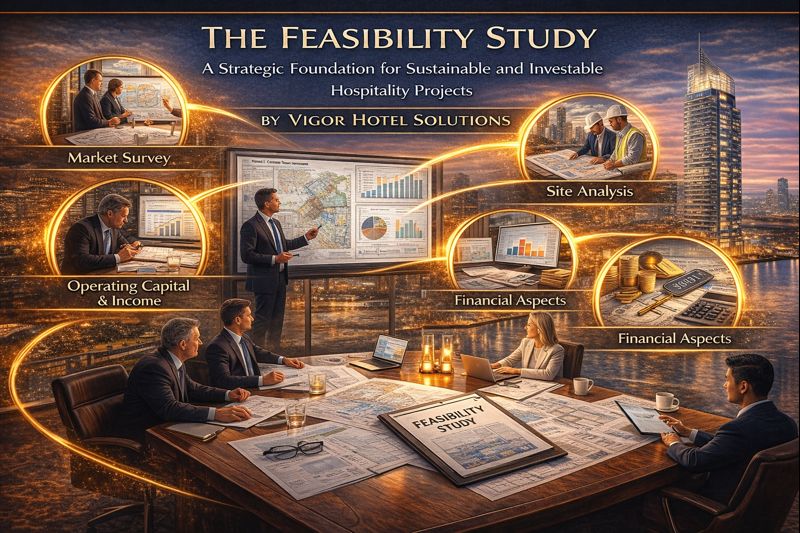
- Market Survey: Understanding Demand Beyond Assumptions
Market analysis must be tailored to asset type:
- Hotels & Resorts:
Demand segmentation (corporate, leisure, MICE, wellness, long-stay), seasonality, length of stay, ADR sensitivity, and brand positioning. - Restaurants:
Catchment analysis, dining frequency, spend per cover, competition density, and lifestyle compatibility. - Mixed-Use Developments:
Synergy between hotel guests, residential occupants, office workers, retail traffic, and destination visitors.
A meaningful market survey goes beyond data—it interprets how guests will actually behave in that specific location.
Experienced hospitality advisors often add value here by translating market data into practical positioning decisions—what to include, what to exclude, and what to scale appropriately.
- Site Analysis: Turning Location into Competitive Advantage
A site does not succeed by geography alone. Each asset type responds differently to location characteristics:
- Hotels benefit from accessibility, visibility, transport nodes, and surrounding demand generators.
- Resorts depend on environmental appeal, privacy, experiential zoning, and land utilization ratios.
- Restaurants rely on footfall patterns, parking convenience, visibility, and adjacency to complementary uses.
- Mixed-use projects require seamless circulation, zoning harmony, and operational separation without losing synergy.
Site analysis must integrate planning regulations, utilities, infrastructure readiness, and long-term development trends, ensuring that design and operations remain viable well beyond opening day.
- Financial Aspects: Reality-Based Numbers, Not Optimistic Models
Financial feasibility should reflect operational truth, not just spreadsheet logic.
Key considerations include:
- Capital expenditure aligned with realistic positioning
- Phased investment for mixed-use developments
- Cost structures appropriate to service level and brand promise
- Sensitivity analysis for occupancy, average spend, and seasonality
Projects benefit when financial models are stress-tested against real operating benchmarks, not generic industry averages.
- Operating Capital: Planning for Stability, Not Survival
Underestimating operating capital is one of the most common causes of early-stage distress.
Each asset type has distinct requirements:
- Hotels & Resorts: Pre-opening payroll, training, marketing ramp-up, working capital for seasonal fluctuations
- Restaurants: Inventory cycles, wastage buffers, staff productivity ramp-up
- Mixed-use developments: Overlapping stabilization timelines across components
Adequate operating capital allows management teams to focus on quality, consistency, and brand reputation, rather than short-term cash pressure.
- Projected Income: Linking Design, Operations, and Revenue Logic
Projected income must be grounded in:
- Space efficiency
- Service design
- Staff productivity
- Guest experience flow
For example:
- A resort’s revenue is driven by experiential layering, not room count alone.
- A restaurant’s profitability depends more on table turnover and menu engineering than seating capacity.
- Mixed-use developments succeed when each component enhances the others’ revenue potential.
Sound projections recognize that revenue is a result of operational design, not an isolated financial assumption.
- Common Problems Identified in Hospitality Feasibility Studies
- Overbuilding without market depth
- Mismatch between concept ambition and operating capability
- Ignoring staffing realities and labor economics
- Underestimating ramp-up periods
- Treating mixed-use components as independent silos
Feasibility studies are most valuable when they reveal what should not be built, as much as what should.
- Exercises for Developers and Investors
- If demand drops by 15%, which component suffers first—and why?
- Can the restaurant survive without hotel guests?
- Does the resort experience justify its CAPEX premium?
- Are shared facilities in mixed-use projects operationally realistic?
- How resilient is the project to staffing shortages?
These exercises often redefine scope before costly commitments are made.
Conclusion: Feasibility as Strategic Leadership
A feasibility study is not a report—it is a leadership tool. It guides investment decisions, design priorities, operational readiness, and long-term resilience.
Projects that engage feasibility as a strategic discipline—integrating market insight, site intelligence, operational logic, and financial realism—consistently outperform those driven by vision alone.
At its best, feasibility transforms hospitality developments from beautiful ideas into profitable, sustainable assets with enduring value.
Selected Bibliography & References
- Rushmore, S. – Hotel Feasibility Studies & Investment Analysis
- Cornell Hospitality Quarterly
- HVS Global Hospitality Reports
- PwC Hospitality Outlook
- UNWTO Tourism Investment Guidelines