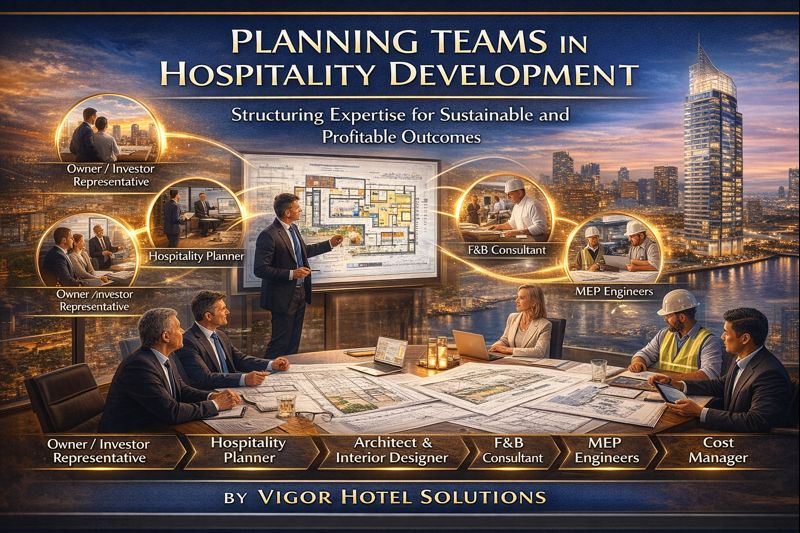
Structuring Expertise for Sustainable and Profitable Outcomes
By Charles Tan , Vigor Hotel Solutions
Introduction
In hospitality development, success is rarely determined by design alone.
It is shaped by the quality of the planning team, the clarity of roles, and the ability to integrate diverse expertise into a single commercial vision.
Hotels, resorts, and restaurants are among the most complex real estate assets. They must satisfy guests, operators, regulators, investors, and staff—often within tight financial and operational constraints.
A well-structured planning team is therefore not a support function; it is a strategic asset.
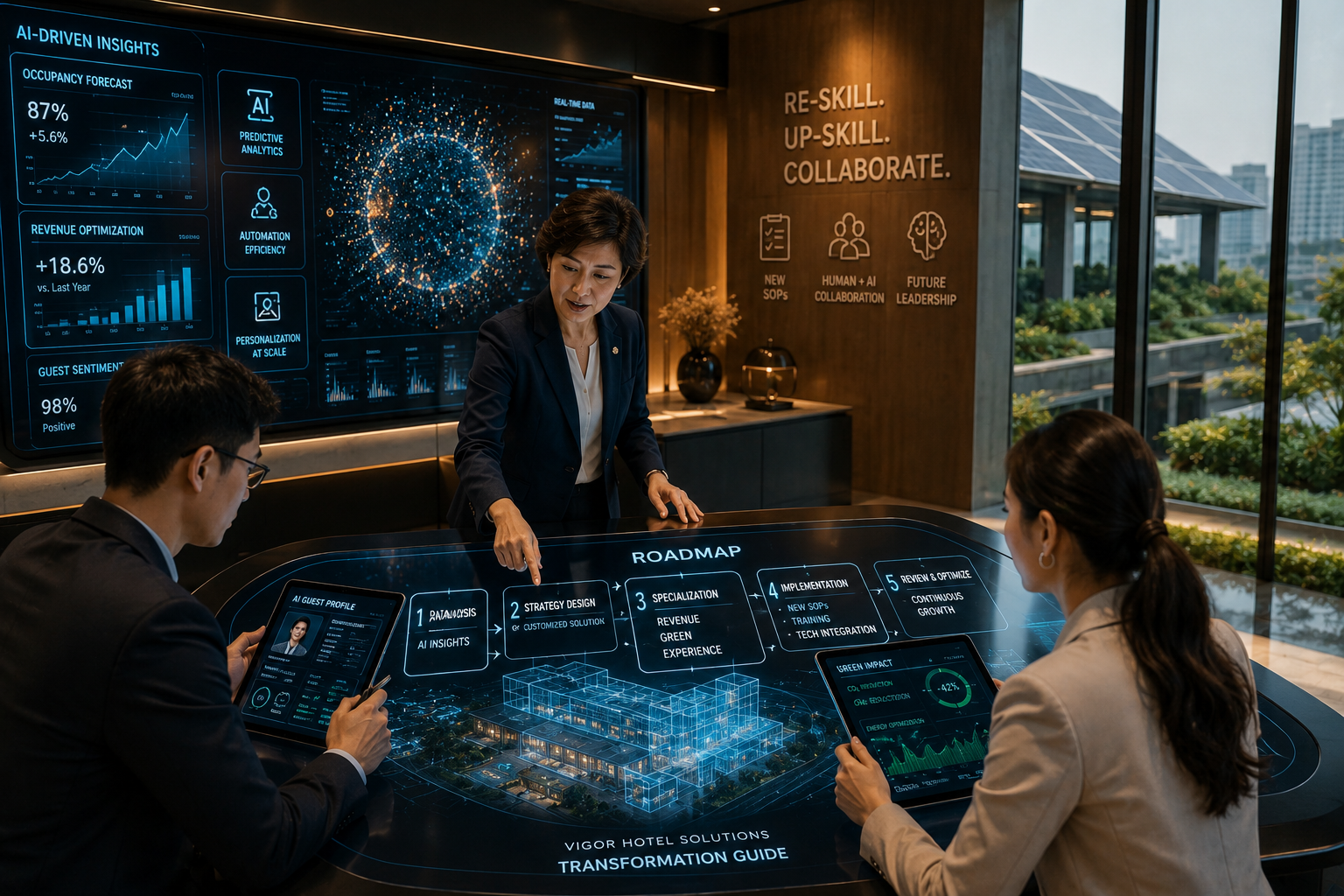
At Vigor Hotel Solutions, we view planning not as a linear process, but as a collaborative system—one that transforms ambition into a viable, revenue-generating hospitality business.
- The Planning Team: Purpose and Structure
A hospitality planning team exists to ensure that concept, space, operations, and financial performance are aligned from the earliest stages.
An effective planning team must:
- Translate the owner’s vision into operational reality
- Anticipate risks before they become costly corrections
- Balance creativity with commercial discipline
- Protect long-term asset value, not just opening-day aesthetics
The most successful projects treat planning as an integrated decision-making platform, rather than a series of disconnected consultant outputs.
- Core Members of the Planning Team
2.1 Owner / Developer Representative
Defines strategic objectives, investment parameters, and risk tolerance.
This role benefits greatly from having an experienced advisor who can challenge assumptions and clarify priorities early.
2.2 Hospitality Planner / Development Advisor
Acts as the central coordinator, ensuring that all disciplines align with the business model, target market, and operating strategy.
This role bridges:
- Vision and feasibility
- Design and operations
- Capital expenditure and long-term profitability
(In many successful developments, this function is embedded from concept to opening to preserve continuity and intent.)
2.3 Architect
Responsible for spatial interpretation, massing, guest flow, and compliance with planning regulations—guided by operational and commercial requirements.
2.4 Interior Designer
Shapes guest experience, brand expression, and emotional connection while working within durability, maintenance, and budget constraints.
2.5 Engineering Consultants (MEP, Structural, IT)
Ensure technical feasibility, energy efficiency, and system resilience that support long-term operational reliability.
- Specialist Advisors on the Planning Team
Modern hospitality projects increasingly rely on specialist expertise, including:
- Food & Beverage Consultants – Concept positioning, kitchen workflow, revenue optimisation
- Operational Consultants – Staffing models, SOPs, service sequencing
- Revenue & Market Analysts – Demand forecasting, pricing strategy, comp set analysis
- Brand & Experience Strategists – Guest journey mapping and differentiation
- Sustainability & ESG Advisors – Resource efficiency and regulatory readiness
The challenge for owners is not access to specialists—but integration.
Without a unifying framework, expert advice can become fragmented and contradictory.
- Contracting for Planning Services
One of the most common risks in hospitality development lies in how planning services are contracted.
Key principles include:
- Clear scope definition tied to decision milestones
- Phased engagement, allowing flexibility as the project evolves
- Single-point accountability to prevent scope gaps or overlaps
- Commercial alignment, ensuring advisors understand financial objectives—not just technical deliverables
Projects benefit significantly when one experienced party oversees coordination, validates assumptions, and ensures continuity across consultants and phases.
- Common Planning Problems and How to Avoid Them
Problem 1: Over-Design, Under-Performance
Beautiful spaces that fail operationally or commercially.
Solution:
Embed operational logic and revenue thinking from the earliest planning stages.
Problem 2: Fragmented Consultant Inputs
Each specialist works in isolation, leading to late-stage conflicts.
Solution:
Establish an integrated planning structure with regular cross-disciplinary reviews.
Problem 3: Unrealistic CapEx and Opex Assumptions
Initial budgets that ignore operational realities.
Solution:
Align design decisions with long-term operating models and lifecycle costs.
Problem 4: Late Discovery of Operational Constraints
Issues identified after construction has begun.
Solution:
Early-stage validation by experienced hospitality practitioners who understand real-world operations.
- Exercises for Owners and Investors
To strengthen planning outcomes, stakeholders should consider the following exercises:
- Vision-to-Reality Mapping
Translate the project vision into operational and financial requirements. - Guest Journey Walkthrough
Evaluate every touchpoint from arrival to departure—both front and back of house. - Operational Stress Testing
Simulate peak periods, staffing shortages, and maintenance scenarios. - Revenue Sensitivity Analysis
Assess how space allocation and design choices impact long-term income.
These exercises often reveal critical insights before irreversible decisions are made.
- The Value of a Trusted Planning Partner
In complex hospitality developments, success is rarely about having more consultants—it is about having the right structure, coordination, and judgment.
Projects benefit when there is a planning partner who:
- Understands hospitality operations end-to-end
- Speaks the language of investors, designers, and operators
- Can identify gaps early and ensure the right expertise is applied at the right time
At Vigor Hotel Solutions, our role is to orchestrate clarity, reduce risk, and help owners move confidently from concept to performance—whether through direct expertise or by assembling and aligning the right specialist capabilities for each project.
Bibliography & Reference Framework
- Rutes, W. A., Penner, R. H., & Adams, L. (Hospitality Design & Planning)
- Cornell School of Hotel Administration – Development Studies
- Hotel & Restaurant Operational Planning Best Practices
- Global Hospitality Asset Management Guidelines
Closing Perspective
Planning is not a preliminary phase—it is a value-defining discipline.
When done correctly, it protects investment, enhances guest experience, and ensures operational sustainability.
The strongest hospitality assets are not those that open fastest—but those that were planned with insight, integration, and intent.
— Vigor Hotel Solutions