Turning Hospitality Vision into Sustainable Revenue
By Charles Tan
In today’s hospitality landscape, sales performance is no longer driven by charisma, location, or price alone.
It is driven by clarity of strategy.
At the heart of that strategy lies one critical foundation:
the Marketing Plan.
A well-designed marketing plan is not a promotional document.
It is the commercial architecture that connects brand intent, customer demand, operational readiness, and long-term financial return.
For hotels, especially in competitive and experience-driven markets such as Thailand, the marketing plan has become the true cornerstone of sales performance.
- Why the Marketing Plan Comes Before Sales
Many hospitality projects still approach marketing as a post-opening activity—something to “activate” once rooms are ready and staff are trained.
This approach often leads to:
- Misaligned pricing
- Over-reliance on OTAs
- Discount-driven demand
- Weak brand equity
- Inconsistent revenue performance
In contrast, high-performing hotels treat the marketing plan as a pre-development discipline.
Before selling a single room, a strong marketing plan answers five essential questions:
- Who exactly are we selling to?
- Why should they choose us over alternatives?
- How will they discover, evaluate, and book us?
- What experience will confirm their decision and drive repeat business?
- How will sales convert demand into profitable revenue—not just occupancy?
When these questions are addressed early, sales becomes execution—not guesswork.
- The Marketing Plan as a Commercial System
From an executive perspective, the marketing plan should be viewed as an integrated commercial system, not a set of campaigns.
Core Components
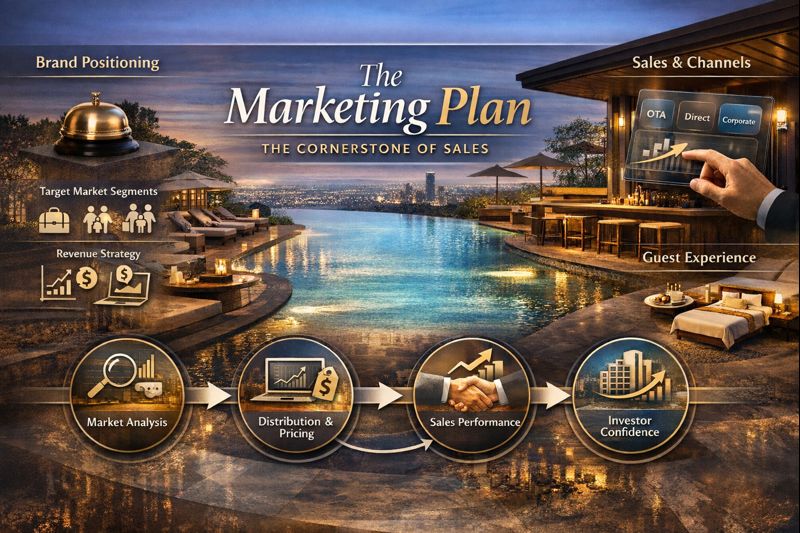
A robust hotel marketing plan aligns four strategic pillars:
- Brand Positioning
Clear definition of:
- Market tier
- Value proposition
- Emotional promise
- Competitive differentiation
This positioning must be realistic, operationally deliverable, and financially defensible.
Many underperforming hotels are not poorly marketed—they are poorly positioned.
- Target Market Architecture
Beyond broad segments, this includes:
- Primary and secondary demand sources
- Purpose of travel
- Booking behavior and decision drivers
- Price sensitivity vs. value sensitivity
Clarity here prevents sales teams from chasing volume that erodes margins.
- Channel & Distribution Strategy
A disciplined plan defines:
- The role of OTAs vs. direct channels
- Corporate, wholesale, and leisure mix
- Market-by-market distribution priorities
- Cost of acquisition benchmarks
Sales success depends less on “selling more” and more on selling through the right channels at the right cost.
- Revenue Logic & Demand Management
Marketing and revenue management must operate as one system.
This includes:
- Pricing architecture
- Promotion rules
- Seasonality strategy
- Yield logic by segment
- Demand stimulation vs. demand capture
Hotels that separate marketing from revenue strategy often win occupancy—but lose profitability.
- Marketing as the Enabler of Sales Excellence
Sales teams perform best when the marketing plan provides:
- Clear market focus
- Strong brand narrative
- Qualified demand
- Consistent messaging
- Logical pricing boundaries
In this environment, sales shifts from reactive discounting to value-based selling.
Sales excellence, therefore, is not built in the sales office—it is built upstream, in the marketing plan.
- The Investor Perspective: Why Marketing Plans Protect Capital
From an investor standpoint, a strong marketing plan:
- Reduces ramp-up risk
- Shortens stabilization period
- Protects ADR integrity
- Improves forecasting reliability
- Enhances asset valuation
Projects with clearly articulated marketing logic are easier to finance, easier to operate, and easier to exit.
In practice, many successful hospitality developments embed marketing strategy into:
- Feasibility studies
- Concept development
- Space planning
- Service design
- Staffing models
This integration transforms marketing from a cost center into a value preservation tool.
- Where Strategic Hospitality Advisors Add Value
In complex hotel projects, the greatest risk often lies not in execution—but in misalignment between vision, market reality, and operational capacity.
Strategic hospitality advisors often play a quiet but critical role by:
- Translating market insights into operationally realistic positioning
- Stress-testing marketing assumptions against cost structures
- Aligning sales objectives with revenue sustainability
- Bridging the gap between creative vision and commercial discipline
This behind-the-scenes alignment is rarely visible to guests—but deeply felt in financial performance.
- Marketing Plan as a Living Framework
A modern marketing plan is not static.
It must:
- Evolve with market conditions
- Respond to demand shifts
- Integrate data and performance feedback
- Support repositioning when required
Hotels that treat the marketing plan as a living framework—rather than a launch document—are better equipped to sustain relevance and profitability over time.
Conclusion: Marketing Is the Architecture of Sales
In hospitality, sales is not an isolated function.
It is the outcome of strategic choices made long before the first booking arrives.
A well-crafted marketing plan provides:
- Direction for sales
- Discipline for pricing
- Clarity for operations
- Confidence for investors
It is, quite simply, the cornerstone upon which sustainable sales performance is built.
In increasingly competitive markets, the hotels that succeed are not those that sell the most—but those that plan the smartest.