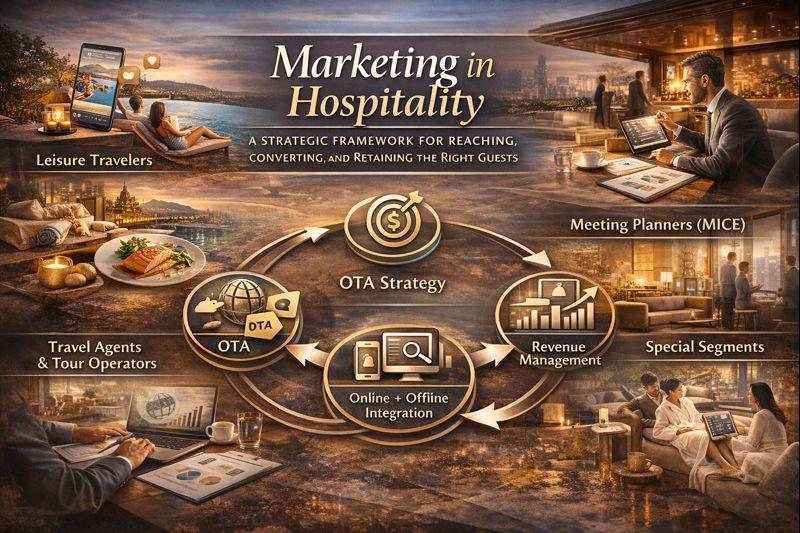
A Strategic Framework for Reaching, Converting, and Retaining the Right Guests
By Charles Tan
In today’s hospitality landscape, marketing is no longer a support function.
It is a core business system that directly influences revenue quality, asset value, and investor confidence.
Effective hospitality marketing is not about visibility alone.
It is about precision—reaching the right guest, through the right channel, at the right price, with a clear value proposition that aligns with operations and revenue strategy.
This article explores a modern, integrated marketing framework for hotels and resorts, addressing key traveler segments while incorporating OTA strategy, online–offline integration, and revenue management as inseparable components of success.
- Marketing to Travelers: A Strategic Overview
Hospitality travelers today are:
- Digitally informed
- Price-sensitive yet experience-driven
- Influenced by reviews, storytelling, and trust signals
Marketing must therefore shift from promotion-led to decision-journey-led thinking.
Key strategic questions:
- Why should this guest choose us over alternatives?
- Through which channel do they discover, evaluate, and book?
- What experience promise are we making—and can operations deliver it consistently?
High-performing hospitality assets design marketing, operations, and revenue management as one connected system, not separate departments.
- Marketing to Leisure Travelers
Who they are:
- Couples, families, lifestyle travelers
- Experience-driven, emotionally motivated
- Strongly influenced by visuals, storytelling, and peer reviews
Strategic Marketing Focus:
- Experience-Led Positioning
Wellness, gastronomy, culture, nature, or lifestyle narratives - Visual & Content Marketing
Photography, video, social storytelling, and UGC - Direct Booking Strategy
Value-added offers rather than price discounting - Seasonality Planning
Different narratives for peak, shoulder, and low seasons
Leisure marketing succeeds when the promise is clear before arrival and fulfilled on property—a point where marketing strategy must align closely with service design and guest journey planning.
- Marketing to Business and Corporate Travelers
Who they are:
- Business executives, project teams, long-stay professionals
- Efficiency-driven, reliability-focused
- Less price-sensitive, more value-conscious
Strategic Marketing Focus:
- Corporate Contracting & Account Management
- Location, Connectivity, and Productivity Messaging
- Consistency of Service Standards
- Direct Sales and Relationship-Based Marketing
Corporate travelers value trust and predictability. Marketing must therefore reflect operational discipline, not just branding.
- Marketing to Travel Agents and Tour Operators
Despite digital disruption, travel agents remain critical—particularly for:
- International markets
- Group travel
- High-value leisure and FIT segments
Strategic Marketing Focus:
- Clear Product Definition
Agents sell clarity, not complexity - Rate Parity and Contract Discipline
- Sales Tools & Agent Education
- Long-Term Market Presence, Not Tactical Promotions
Agent marketing is most effective when supported by structured pricing logic and reliable inventory control—areas where revenue management and marketing must work hand in hand.
- Marketing to Meeting Planners (MICE)
Who they are:
- Corporate planners, associations, incentive houses
- Risk-averse, outcome-focused, detail-driven
Strategic Marketing Focus:
- Capability-Based Messaging
Space, technology, flow, and operational readiness - Experience Beyond the Meeting Room
- Clear Financial Logic
- Post-Event Value Creation
Meeting planners do not buy venues—they buy execution certainty.
Marketing success here depends on operational credibility and integrated planning across departments.
- Marketing to Special Segments
Special segments offer high-margin opportunities when strategically positioned:
- Wellness & medical tourism
- Luxury & ultra-high-net-worth travelers
- Long-stay & expatriates
- Sustainability-driven guests
- Culinary and lifestyle niches
Strategic Marketing Focus:
- Niche-Specific Messaging
- Authenticity and Proof of Expertise
- Selective Channels, Not Mass Exposure
- Tailored Experience Design
Targeted segments require strategic restraint—not every guest is the right guest.
- OTA Strategy: Visibility Without Dependency
OTAs are not the enemy—but dependency is the risk.
Strategic Role of OTAs:
- Market entry and brand exposure
- Demand stimulation during low periods
- Access to international feeder markets
Smart OTA Management Includes:
- Controlled inventory allocation
- Channel-specific pricing strategy
- Clear differentiation of direct booking benefits
- Continuous performance analysis
Successful hotels use OTAs as marketing platforms, not as permanent sales crutches.
- Online–Offline Integration (O2O Marketing)
Modern hospitality marketing must connect:
- Digital discovery → On-property experience → Post-stay engagement
Key elements:
- Seamless brand messaging across touchpoints
- Data-driven personalization
- Reputation and review management
- CRM integration
The guest journey does not end at check-out—it evolves into loyalty, advocacy, and lifetime value.
- Revenue Management as a Marketing Discipline
Marketing without revenue logic leads to volume without profit.
Integrated marketing must work alongside:
- Demand forecasting
- Dynamic pricing
- Segment profitability analysis
- Length-of-stay optimization
In high-performing assets, marketing creates demand, while revenue management shapes demand into profitability.
The Strategic Role Behind the Scenes
In complex hospitality environments, aligning marketing with operations, pricing, and long-term asset strategy requires a holistic advisory mindset—one that understands both brand storytelling and commercial discipline.
This is often where experienced hospitality advisors quietly add value:
by structuring marketing frameworks that are realistic, executable, and financially sound—rather than promotional in isolation.
Conclusion
Hospitality marketing today is not about being louder.
It is about being clearer, smarter, and more aligned.
Whether marketing to:
- Leisure travelers
- Corporate clients
- Travel agents
- Meeting planners
- Or niche segments
The ultimate goal remains the same:
To attract the right guests, through the right channels, at the right price—while delivering an experience that sustains revenue and asset value over time.