By Charles Tan
In the past, a successful restaurant was defined by good food, strong service, and a favorable location.
Today, restaurants that survive and grow are those that understand how to leverage digital platforms and food delivery as part of their core business system.
Digital platforms are no longer simply ordering tools.
They have become critical components of the customer journey, revenue model, and brand visibility in the modern restaurant industry.
- How Digital Platforms Have Redefined the Restaurant Landscape
Digital platforms allow restaurants to:
- Extend their reach beyond physical locations
- Acquire new customers without opening new outlets
- Collect real-time data on customer behavior
- Compete alongside larger brands on equal digital ground
At the same time, they introduce new challenges:
- High commission structures
- Price-driven competition
- Brand ownership shifting toward platforms
The strategic question is no longer whether to use digital platforms, but how to manage them intelligently.
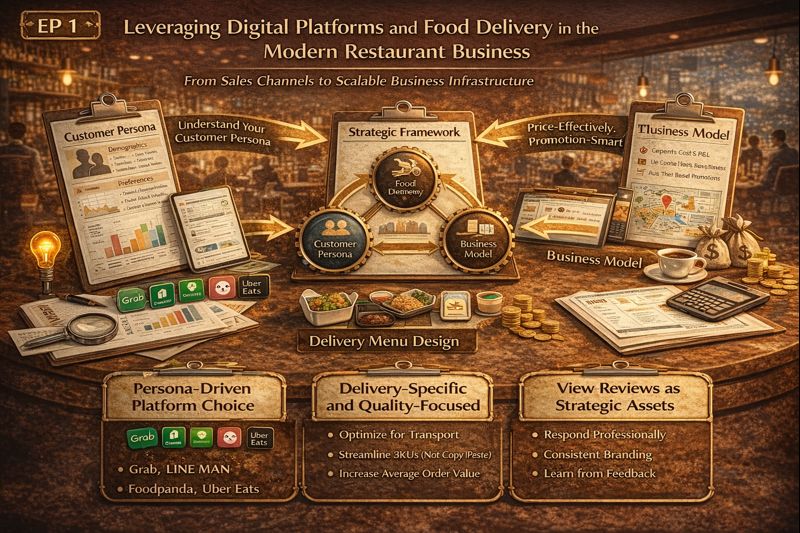
- Start with Customer Persona, Not with Platforms
Many restaurants fail because they adopt digital platforms indiscriminately.
The right strategic question is not:
“Which delivery app should we use?”
But rather:
“Who is our core customer, and how do they actually order food?”
Common Customer Personas include:
- Urban Convenience Seekers
Value speed, accessibility, competitive pricing, and strong reviews. - Family & Value Buyers
Order in groups, prioritize consistency, portion size, and perceived value. - Premium Experience Diners
Seek brand story, presentation, packaging quality, and emotional connection—even through delivery.
Once personas are clearly defined, decisions regarding platforms, communication style, menu design, and pricing become focused and strategic.
- Not Every Menu Item Is Meant for Delivery
One of the most common operational mistakes is uploading the entire dine-in menu to delivery platforms.
Successful operators:
- Design delivery-specific menus
- Reduce SKU complexity
- Select items that maintain quality during transportation
A simple principle applies:
Menus optimized for dine-in are not automatically suitable for delivery.
- Delivery Pricing Is a Strategic Decision
Restaurants that lose money on delivery often:
- Use dine-in pricing without adjustment
- Discount aggressively without understanding true margins
- Fail to separate delivery costs from core P&L analysis
Sustainable approaches include:
- Transparent delivery pricing structures
- Curated combo sets to increase average order value
- Time-based promotions instead of permanent discounts
Delivery pricing must reflect cost reality, brand positioning, and long-term viability.
- Reviews Are Strategic Assets, Not Random Outcomes
In the digital ecosystem, reviews are not a matter of luck—they are indicators of operational consistency.
High-performing restaurants:
- Respond to reviews professionally and consistently
- Address recurring operational pain points reflected in feedback
- Treat reviews as data inputs for continuous improvement
EP 1 Summary
Digital platforms and food delivery can either become growth accelerators or margin traps.
The difference lies in whether the restaurant:
- Understands its customer deeply
- Designs menus and pricing intentionally
- Manages platforms strategically rather than reactively