Turning Food Delivery into a Long-Term Profit Engine
By Charles Tan
If EP 1 focuses on establishing a solid foundation,
EP 2 addresses strategic maturity.
Restaurants that scale successfully look beyond order volume and ask:
“How do we grow using platforms—without becoming controlled by them?”
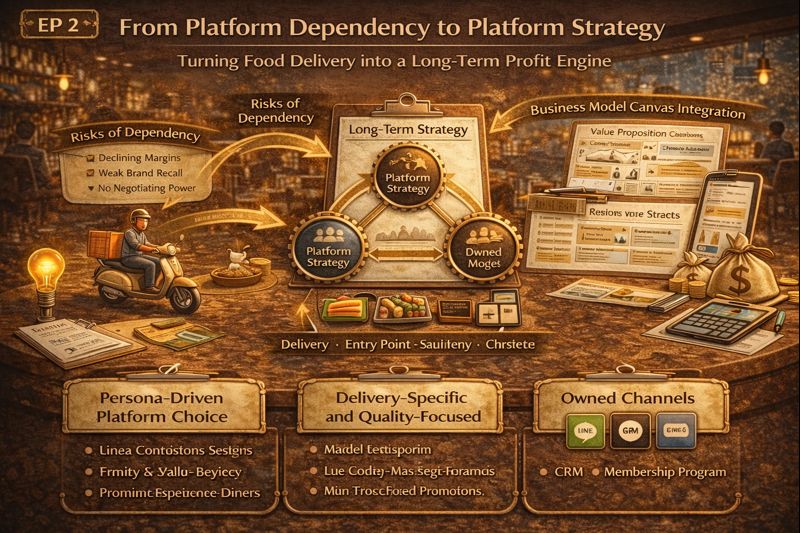
- The Risks of Platform Dependency
Over-reliance on delivery platforms leads to:
- Declining margins
- Weak brand recall
- Limited negotiating power
This is why modern restaurants must shift from
Platform Dependency → Platform Strategy.
- The True Role of Food Delivery Platforms
Food delivery platforms should be treated as:
- Customer acquisition tools
- Market-testing environments
- Entry points for brand discovery
They should not become:
- The only revenue channel
- A long-term loss-leader strategy
- Integrating Digital Platforms into the Business Model Canvas
High-performing restaurants embed digital platforms directly into their business model:
- Value Proposition
Consistent food quality delivered without compromising brand standards - Channels
Delivery platforms integrated with owned channels (LINE OA, CRM, website) - Customer Relationships
Loyalty programs, re-order prompts, personalized offers - Revenue Streams
Bundles, delivery-exclusive menus, curated sets - Cost Structure
Platform commissions, packaging innovation, digital advertising
This integration ensures delivery supports—not distorts—the core business.
- Owned Channels Are the Key to Sustainability
The long-term objective is not to abandon platforms, but to reduce dependency.
Leading restaurants:
- Acquire customers via platforms
- Transition them into owned channels
- Build direct relationships that lower recurring acquisition costs
Owned channels create control, resilience, and long-term value.
- Digital Platforms as Management Tools, Not Just Marketing Channels
Digitally mature restaurants use data to:
- Optimize labor planning
- Control food and packaging costs
- Design behavior-based promotions
- Make decisions based on evidence rather than intuition
EP 2 Summary
Restaurants that succeed in the digital era are not those that simply “sell well on apps.”
They are those that design systems that grow through platforms—without being governed by them.