Advertising, Public Relations, and Publicity
Strategic Levers That Shape Demand, Reputation, and Long-Term Value
By Charles Tan
In today’s hospitality landscape, marketing is no longer a support function.
It is a core business driver that directly influences demand creation, pricing power, brand equity, and ultimately asset value.
Among all marketing disciplines, Advertising, Public Relations, and Publicity remain the most misunderstood—and often misused—tools.
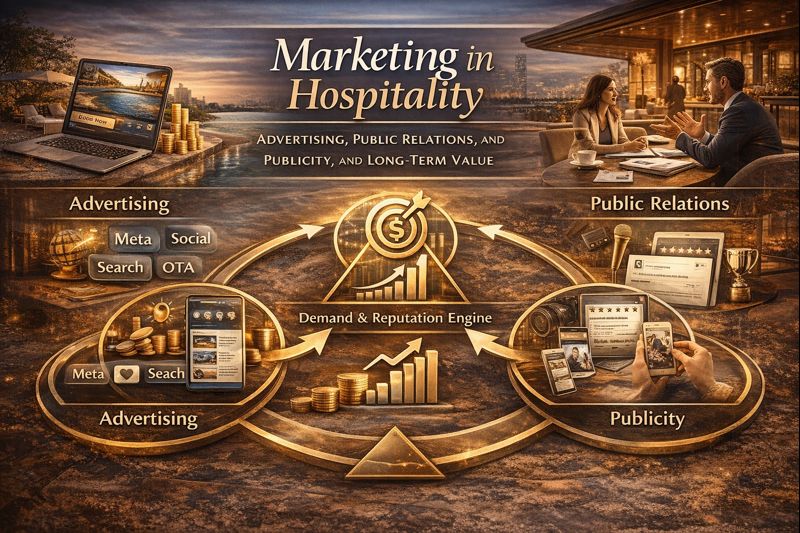
When applied strategically, they work together as a demand engine.
When applied tactically or in isolation, they become cost centres with limited return.
- Advertising: Creating Predictable Demand, Not Just Visibility
From Awareness to Commercial Impact
In hospitality, advertising is often mistaken for “being visible.”
In reality, effective advertising is about engineering demand at the right time, from the right segments, at the right cost.
Modern hotel advertising must be:
- Data-driven, not intuition-based
- Integrated with revenue management
- Closely aligned with brand positioning and distribution strategy
Key Advertising Channels in Hospitality Today
Digital & Performance Media
- Search (Brand & Non-brand keywords)
- Meta-search platforms
- Social media performance campaigns
- Retargeting and lookalike audiences
OTA-Related Advertising
- Sponsored listings
- Visibility boosters
- Tactical campaigns during need periods
Offline & Hybrid Media
- Strategic print placements (not mass circulation)
- Airport, premium lifestyle, and destination-based media
- Selective out-of-home for resort and mixed-use assets
Well-structured advertising does not compete with revenue management—it supports it by shaping demand patterns rather than discounting prices.
- Public Relations (PR): Managing Trust, Narrative, and Long-Term Reputation
PR Is Not Exposure — It Is Reputation Architecture
Public Relations in hospitality is not about press releases or occasional media mentions.
It is about controlling the narrative of the property, brand, or development.
Effective PR answers three questions:
- Who are we in the market?
- Why should guests, partners, and investors trust us?
- How are we different—credibly, not loudly?
Strategic Roles of PR in Hospitality
- Brand storytelling and positioning
- Crisis and reputation management
- Investor and stakeholder confidence
- Employer branding and talent attraction
- Destination and community integration
In many successful hotel and resort projects, PR begins before opening, shaping expectations long before the first guest arrives.
- Publicity: Earning Attention Without Paying for It
The Most Credible Form of Marketing
Publicity refers to earned exposure—media coverage, reviews, features, influencer mentions, and organic word-of-mouth.
Unlike advertising, publicity is not bought.
Its power lies in third-party validation, which is especially influential in hospitality purchasing decisions.
Modern Sources of Hospitality Publicity
- Online reviews and reputation platforms
- Travel, lifestyle, and business media
- Influencer and content creator collaborations
- Awards, rankings, and industry recognition
- User-generated content amplified through social platforms
In the digital era, publicity travels faster—and lasts longer—than any paid campaign.
- Integrating Advertising, PR, and Publicity into One System
The real competitive advantage lies not in choosing one tool, but in orchestrating all three.
|
Discipline |
Primary Role |
Time Horizon |
|
Advertising |
Demand creation & conversion |
Short to medium term |
|
Public Relations |
Trust & brand narrative |
Medium to long term |
|
Publicity |
Credibility & amplification |
Long term |
When aligned correctly, these elements:
- Reduce dependency on price discounting
- Improve channel mix and distribution efficiency
- Strengthen brand equity and resale value
- Support sustainable revenue growth
- Common Pitfalls in Hospitality Marketing
Many hospitality businesses struggle not because they under-invest in marketing, but because they invest without structure.
Typical issues include:
- Advertising without clear target segmentation
- PR activities disconnected from business strategy
- Over-reliance on OTAs without brand-building
- Short-term promotions eroding long-term value
- Marketing decisions made without operational or financial alignment
A structured marketing framework helps transform marketing from a cost into a strategic asset.
- Where Strategic Advisory Makes the Difference
In complex hospitality environments, marketing decisions intersect with:
- Revenue management
- Distribution strategy
- Operational capacity
- Brand positioning
- Financial performance
Projects that benefit most are those where marketing strategy is developed alongside feasibility, concept design, and operational planning—not after opening.
This integrated approach allows marketing to:
- Support yield optimisation
- Strengthen investor confidence
- Align guest experience with brand promise
- Protect long-term asset value
Conclusion: Marketing as a Value Creation Tool
Advertising, Public Relations, and Publicity are not isolated activities.
They are strategic levers that shape how a hospitality asset performs in the market—financially and reputationally.
For hotels, resorts, restaurants, and mixed-use developments,
the most successful projects are those that treat marketing as:
A system designed to create trust, stimulate demand, and sustain value—over time.