Designing Efficient, Scalable, and Profitable Food & Service Systems
By Charles Tan, Vigor Hotel Solutions
Introduction: Why Functional Planning Defines Long-Term Success
In hospitality development, functional planning is not merely about arranging spaces—it is about orchestrating people, processes, and performance into a seamless operational ecosystem.
Whether in a hotel, resort, restaurant, or central kitchen, functional planning determines:
- Operational efficiency
- Cost control
- Staff productivity
- Food safety and quality
- Guest experience consistency
- Long-term scalability
Poor functional planning leads to inefficiencies that no amount of branding or marketing can correct. Conversely, well-designed functional systems quietly generate profitability every single day.
At Vigor Hotel Solutions, functional planning is approached as a strategic business discipline, not just a technical exercise.
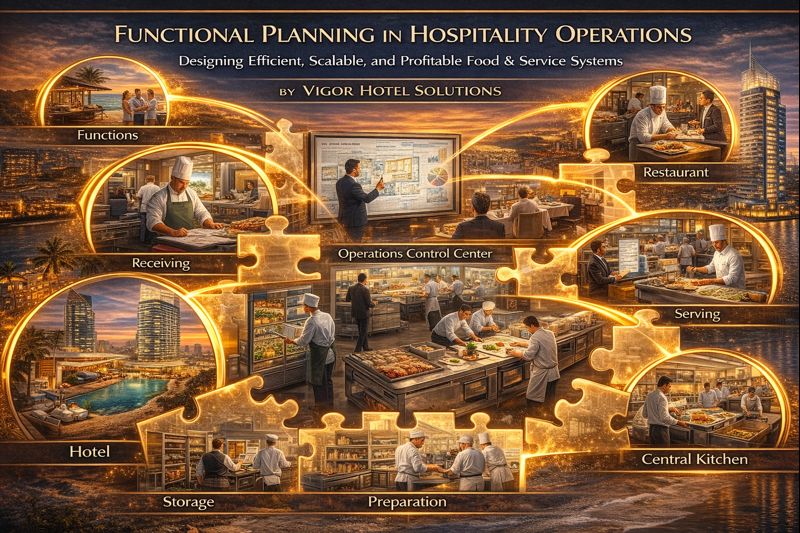
- Functions: Defining the Purpose of Each Space
Every space must serve a clear operational function, aligned with the business model.
By Asset Type:
- Hotel: Multi-outlet kitchens, room service, banqueting, staff dining
- Resort: High-volume seasonal outlets, beach bars, experiential dining
- Restaurant: Speed, consistency, visibility, brand storytelling
- Central Kitchen: Production efficiency, standardization, logistics control
A space without a defined function inevitably becomes an operational bottleneck.
- The Concept of Flow: From Receiving to Disposal
Functional flow ensures that:
- Raw materials move forward
- Finished products move outward
- Waste moves away
- Staff movement never crosses contamination paths
Key Principles:
- One-directional flow
- Separation of clean and dirty zones
- Logical adjacency between tasks
Flow planning is where many projects fail—especially when architectural aesthetics override operational logic.
- Functional Requirements: Designing for Real Operations
Functional requirements include:
- Capacity planning
- Equipment sizing
- Labor flow
- Hygiene and safety compliance
- Peak-period performance
Vigor often supports developers at this stage by translating conceptual ideas into operationally realistic requirements, preventing costly redesigns later.
- Receiving Areas
Core Considerations:
- Direct access from service roads
- Inspection space
- Temperature control
- Security and traceability
Hotel & Resort: Multiple suppliers, high frequency
Restaurant: Compact but controlled
Central Kitchen: Bulk receiving with strict QC protocols
- Storage Systems
Storage Categories:
- Dry storage
- Chilled storage
- Frozen storage
- Chemical and non-food storage
Efficient storage reduces waste, improves inventory turnover, and supports food safety standards such as HACCP.
- Preparation Areas
Preparation must be separated by function:
- Vegetable prep
- Meat & seafood prep
- Pastry & bakery prep
This is especially critical in resorts and central kitchens, where cross-contamination risks are magnified by volume.
- Cooking & Production Zones
Cooking zones must align with:
- Menu complexity
- Production volume
- Skill level of staff
Asset-Specific Focus:
- Hotel: Multi-cuisine flexibility
- Resort: High-output during peak seasons
- Restaurant: Speed and consistency
- Central Kitchen: Batch production and standardization
Vigor frequently assists in balancing menu ambition with operational reality, ensuring kitchens perform sustainably.
- Baking & Pastry Operations
Often underestimated, bakery functions require:
- Dedicated climate control
- Specialized equipment
- Clear workflow separation
Centralized pastry production is increasingly popular for hotels and resort groups seeking consistency and cost control.
- Serving & Dispatch Areas
Serving zones must ensure:
- Speed
- Accuracy
- Temperature control
Room service dispatch, banquet service lines, and restaurant pass-throughs all require tailored planning to maintain service excellence.
- Dishwashing Systems
Efficient dishwashing is vital for hygiene and labor efficiency.
Considerations:
- Separate pot wash and dish wash
- Logical return flow
- Noise and heat management
Poor dishwashing layouts are a common hidden cost in hospitality operations.
- Pot & Pan Washing
Heavy-duty washing requires:
- Durable flooring
- Adequate drainage
- Ergonomic layouts
This area directly impacts kitchen morale and equipment lifespan.
- Waste Disposal & Sustainability
Waste management must address:
- Food waste
- Recyclables
- Hazardous waste
Modern hospitality projects increasingly integrate waste reduction and sustainability strategies, which Vigor often helps align with local regulations and ESG expectations.
- Other Functional Requirements
- Staff changing rooms
- Staff dining
- Engineering access
- IT and POS integration
- Fire and safety systems
These “invisible” spaces often determine whether operations feel effortless—or constantly strained.
- Common Problems in Functional Planning
- Over-designed kitchens with under-skilled labor
- Aesthetic-driven layouts with poor flow
- Inadequate storage capacity
- Underestimated dishwashing requirements
- No allowance for future expansion
- Exercises for Developers & Operators
- Walk the full operational flow on paper—step by step
- Identify crossing paths and congestion points
- Test peak-hour scenarios
- Simulate staff movement, not just equipment placement
Conclusion: Functional Planning as a Competitive Advantage
Functional planning is where profitability is quietly engineered.
Well-planned hospitality operations:
- Reduce operating costs
- Improve staff efficiency
- Enhance food quality
- Deliver consistent guest experiences
- Scale smoothly with growth
At Vigor Hotel Solutions, functional planning is treated as a strategic investment, integrating design, operations, and financial logic into one coherent system.
Bibliography
- Foodservice Planning & Design Guidelines – IFMA
- Hospitality Facilities Planning – Powers & Barrows
- HACCP Principles – FAO / WHO
- Hotel & Restaurant Design Standards – AHLA
- Professional Kitchen Design – Jones & Merricks