-
Finance, Marketing, Operations, People
AI in Hospitality: Partner, Not Replacement
By Charles Tan — VIGOR Hotel Solutions (Precision with Soul)
Executive Summary
AI is not a magic box that replaces hotel staff. It’s a powerful set of tools that, when thoughtfully applied, augments human skill, speeds decisions, reduces repetitive work, and improves guest experiences. The correct mindset is: use AI to do what machines do best — data processing, pattern detection, repetitive tasks — and free people to do what humans do best — empathy, creativity, problem-solving, and leadership.
1. Why AI matters for hotels and restaurants now
· Data everywhere: PMS, POS, CRM, OTAs, sensors, review platforms — AI turns this noise into actionable insight.
· Speed & scale: AI can analyze booking trends, predict demand, and personalize offers far faster than humans alone.
· Cost pressure: Rising wages and commission costs make efficiency gains from AI compelling.
· Guest expectations: Modern guests expect quick, personalized service across channels — AI helps deliver it consistently.
2. Misconceptions to clear up first
· “AI will take all our jobs.” Not true. Routine and repetitive tasks may be automated, but roles will evolve. New jobs will emerge (AI operators, data stewards, guest-experience designers).
· “AI is plug-and-play.” No — it needs clean data, clear objectives, and human oversight.
· “AI = less human touch.” Done well, AI increases moments of genuine human service by freeing time from low-value tasks.
3. Where AI is an immediate partner (practical use cases)
3.1 Revenue & Distribution — Smarter pricing
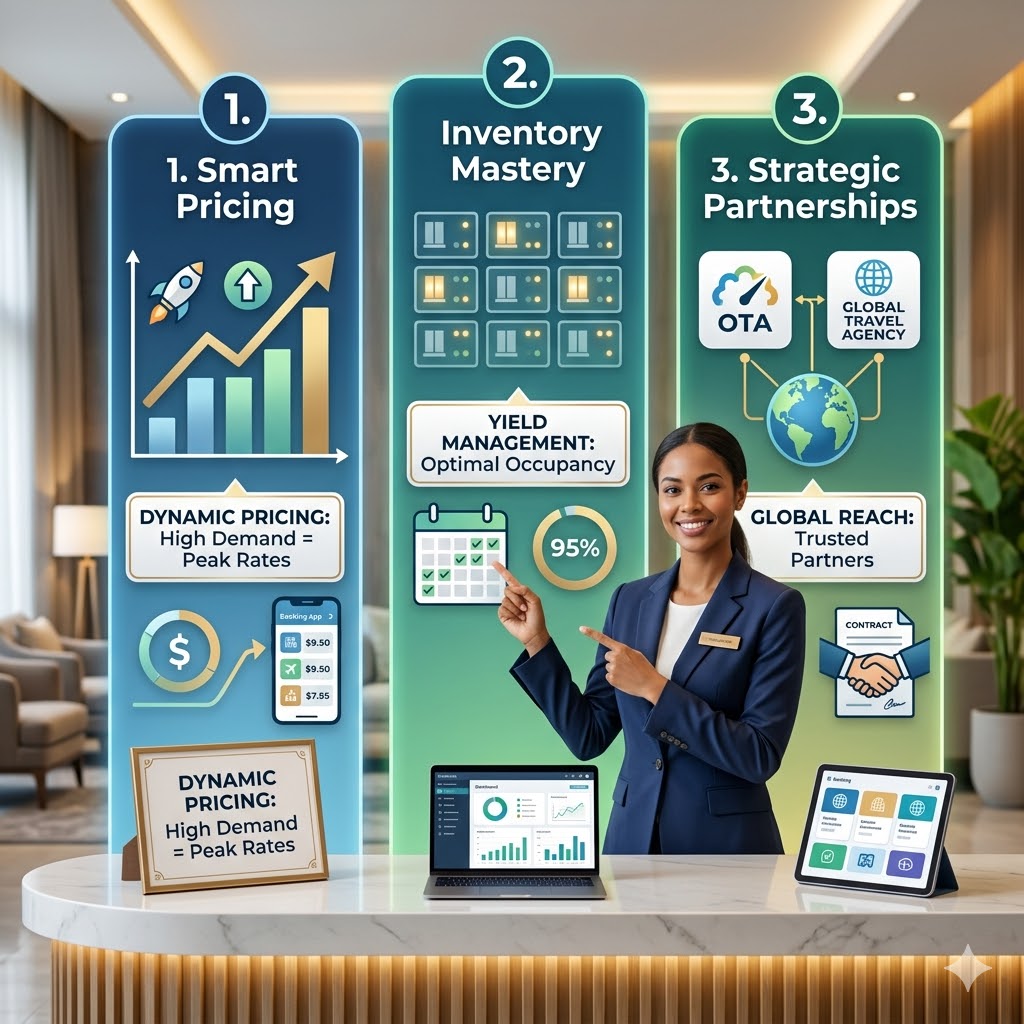
· Demand forecasting & dynamic pricing: AI models use booking pace, local events, competitor rates, and weather to recommend rates per channel.
· Channel mix optimization: AI suggests which OTA promotions to accept and when to push direct-booking offers.
3.2 Reservations & Sales — Faster response, higher conversion
· Intelligent chat & booking assistants: 24/7 handling of routine queries, availability checks, and simple bookings; handover to humans for complex/group business.
· Lead scoring for groups/corporate: AI ranks enquiries by booking probability and value so sales prioritizes high-potential leads.
3.3 Guest experience & personalization
· Personalized upsell/cross-sell: AI recommends spa, F&B or room upgrades based on guest profile & past behavior.
· Pre-arrival personalization: Dietary preferences, pillow type, celebration notes are surfaced to staff before guest arrival.
3.4 Operations & back-of-house efficiency
· Housekeeping optimization: AI predicts check-out patterns and optimizes room-cleaning routes and staff allocation.
· Maintenance prediction: IoT sensors + AI predict equipment failure (HVAC, kitchen) and schedule preventative maintenance.
· Inventory control: AI forecasts F&B consumption and suggests ordering to reduce waste.
3.5 Reputation & marketing
· Review analysis: AI aggregates reviews and flags root causes (cleanliness, service, noise) for immediate action.
· Segmented marketing: AI builds micro-segments and runs highly targeted campaigns (e.g., repeat spa guests with couples packages).
4. Roles that shift — not disappear
· Frontline staff: move from repetitive check-in tasks to welcoming, upselling, and recovery work.
· Housekeeping leads: use AI schedules and spend more time quality-checking and guest care.
· Revenue Manager: becomes strategic interpreter of AI suggestions, setting guardrails and exception rules.
· Sales & Event teams: focus on relationship builds, complex negotiations and experience design.
· New roles: AI Trainer, Data Steward, Automation Manager, Guest Experience Designer.
5. Implementation principles — how to adopt AI safely and effectively
Principle A — Start with business problems, not tools
Pick one high-impact problem (e.g., reduce check-out time, reduce food waste, improve direct-booking rate) and pilot an AI solution against it.
Principle B — Clean, governed data first
AI requires good data. Clean your guest profiles, booking data, menu items, and inventory records before deploying models.
Principle C — Maintain human-in-the-loop
Always set clear escalation paths. AI suggests; humans decide on exceptions, complex guest handling, and reputation-sensitive issues.
Principle D — Define guardrails & ethics
Set policies for privacy, data retention, explainability, and bias mitigation (e.g., don’t price-discriminate unfairly). Comply with local data laws.
Principle E — Start small, scale fast
Pilot in one outlet or function; measure ROI, fix data/process issues, then scale.
Principle F — Train the team
Invest in change management: teach staff what AI does, what it won’t do, and how their jobs will evolve.
6. Risks and how to mitigate them
Risk: Data privacy & misuse
Mitigation: clear guest consent, anonymize analytics, and follow local privacy laws.
Risk: Over-reliance / blind acceptance of AI
Mitigation: require transparency (why a recommendation is made) and human sign-off for high-impact decisions.
Risk: Biases in models
Mitigation: test models for fairness (e.g., pricing or promotion recommendations must be audited).
Risk: Poor guest perception (too automated)
Mitigation: balance automation with human moments — use AI to create more meaningful human interactions, not to replace them.
7. KPIs to measure AI success (practical examples)
· Conversion uplift from AI chat / booking assistant (% increase).
· RevPAR uplift attributable to dynamic pricing (incremental revenue).
· Housekeeping efficiency (rooms per staff-hour, % on-time ready).
· Maintenance cost reduction (downtime avoided / emergency repair reductions).
· F&B waste reduction (%) through better forecasting.
· Guest satisfaction delta (NPS or review score change) post personalization rollout.
· Time saved on administrative tasks (hours/week).
8. Practical roadmap (90-day pilot | scale plan)
Days 1–30: Discovery & data prep
· Identify use-case and stakeholders. Clean data, identify KPIs and success criteria.
Days 31–60: Pilot implementation
· Deploy a minimal viable AI (e.g., chat assistant, housekeeping optimizer). Train staff and run in shadow mode.
Days 61–90: Measure & refine
· Compare KPIs vs baseline. Fix data/process gaps. Draft SOPs for human-AI workflows.
Months 4–12: Scale & govern
· Roll out to more outlets/functions. Establish AI governance board, data stewardship and training programs.
9. Case vignette (illustrative)
A 120-room resort pilots AI housekeeping scheduling. Using 12 months of stay patterns and check-out timings, AI predicts daily cleaning demand and optimizes staff allocation. Result: 20% reduction in overtime, 15% faster room-ready times, and improved guest check-in satisfaction.
10. Practical checklist before you buy an AI solution
· Do we have clean data for this use case?
· Who owns the data and model outputs? (assign Data Steward)
· What is the human escalation path?
· What KPIs will show success within 90 days?
· Is there an exit plan if results are poor?
· Does the vendor comply with local privacy laws?
· Have we planned staff training & communication?
11. Final thoughts — strategy, not hype
AI is neither panacea nor threat when treated with balance. For hospitality, the best outcomes come when AI increases staff capacity to create memorable human moments — when machines do the heavy thinking and people do the heavy caring. Adopt thoughtfully, govern responsibly, and use AI as your partner to raise guest experiences, not to replace the heart of hospitality.
Share the Post:
Related Posts