A Practical Restaurant Strategy Series (EP 1–2)
EP 1: Understanding Food Cost Before It Controls Your Business
From Accounting Numbers to Operational Reality
By Charles Tan
Introduction
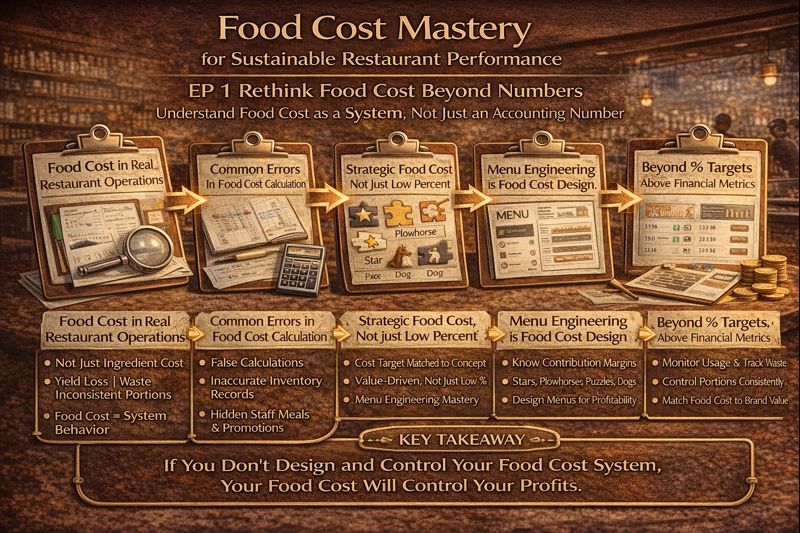
In the restaurant business, food cost is often discussed as a percentage—but rarely understood as a system. Many restaurants report strong sales yet struggle to generate sustainable profit because food cost is managed reactively, not strategically.
Food cost is not merely an accounting figure. It is the cumulative result of menu design, purchasing decisions, kitchen discipline, staff behavior, and leadership clarity.
- What Food Cost Really Means in Practice
Food cost goes far beyond ingredient prices. It includes:
- Yield loss during preparation
- Inconsistent portioning
- Overproduction and waste
- Complimentary items, staff meals, and promotions
- High-volume, low-margin menu items
In reality, food cost reflects how well—or poorly—the restaurant’s system is designed and executed.
- Why Food Cost Calculations Often Mislead Operators
The standard formula:
Food Cost % = (Actual food usage ÷ Food sales) × 100
While correct in theory, it often fails in practice due to:
- Inaccurate opening and closing inventory
- Unrecorded staff consumption
- Promotional giveaways not tracked as cost
- Off-menu items prepared outside standard recipes
Effective food cost control begins with data accuracy and operational discipline, not spreadsheets alone.
- Food Cost as a Strategic Decision
The right food cost level depends on the restaurant’s concept and value proposition:
- Quick-service restaurants rely on tight food cost control and volume efficiency
- Casual dining balances perceived value with portion management
- Premium or fine dining accepts higher food cost in exchange for margin, pricing power, and experience
A low food cost percentage is not a success metric if it undermines brand promise.
- Menu Engineering: Designing Food Cost in Advance
The menu determines food cost before the first order is placed.
Key principles:
- Focus on contribution margin, not food cost percentage alone
- Classify menu items as Stars, Plowhorses, Puzzles, or Dogs
- Identify items that sell well but quietly erode profit
Restaurants that do not engineer their menus allow food cost to dictate profitability instead of the other way around.
EP 1 Key Takeaway
If food cost is not intentionally designed, it will quietly design your profit—often in the wrong direction.