Systems That Protect Quality, Teams, and Brand
By Charles Tan
Introduction
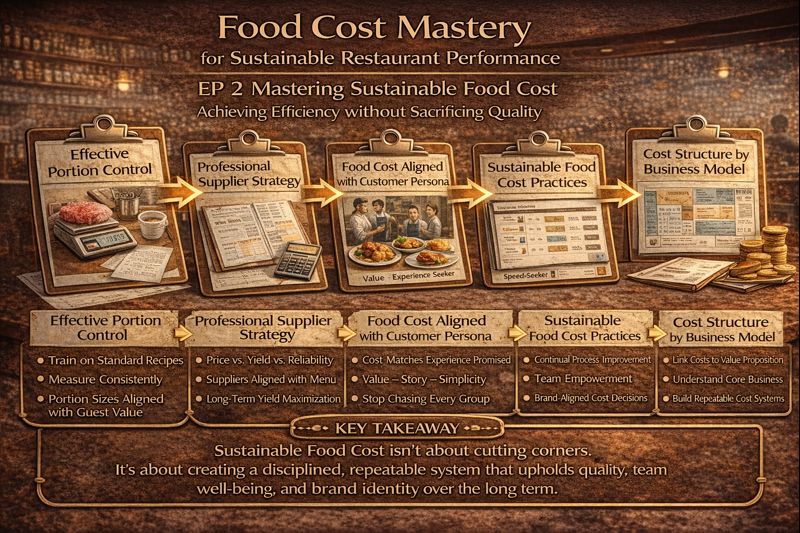
Short-term food cost reductions often come at a long-term price: declining quality, staff fatigue, and brand erosion. Sustainable food cost control requires systems, not shortcuts.
- Portion Control: Small Variations, Big Consequences
Inconsistent portioning is one of the largest hidden food cost leaks.
Sustainable approaches include:
- Practical, enforceable standard recipes
- Portion sizes aligned with customer value perception
- Training that explains the “why,” not just the rule
Portion control protects margins without diminishing guest satisfaction.
- Purchasing and Supplier Strategy
Food cost is not controlled by negotiating price alone.
Key considerations:
- Ingredient consistency and yield
- Reliability of supply
- Alignment between suppliers, menu design, and volume
Lower-priced ingredients with higher waste often cost more in the end.
- Aligning Food Cost with Customer Persona
Different customers justify different cost structures:
- Value-driven customers prioritize portion and price consistency
- Experience-driven diners value quality, presentation, and story
- Speed-driven customers benefit from simplified menus that reduce waste
Attempting to serve all personas equally often results in uncontrolled food cost.
- What Sustainable Food Cost Really Means
Sustainable food cost means:
- Stable margins over time
- No compromise on core quality
- Operational systems that teams can execute consistently
- A brand that does not rely on constant discounting
Sustainability is discipline applied daily—not a one-time initiative.
- Food Cost Within the Business Model Canvas
Food cost sits within the Cost Structure and must align with:
- Value Proposition
- Key Activities
- Customer Segments
Every cost decision should clearly support how value is created and monetized.
EP 2 Key Takeaway
Sustainable food cost control is not about spending less—it is about spending intentionally, consistently, and strategically.
Series Closing Perspective
Food cost mastery is a leadership responsibility.
Restaurants that succeed long term:
- Understand food cost as a system
- Design menus and operations deliberately
- Align cost control with customer value and brand positioning
Food cost should never be a monthly surprise—it should be a predictable outcome of a well-designed restaurant system.