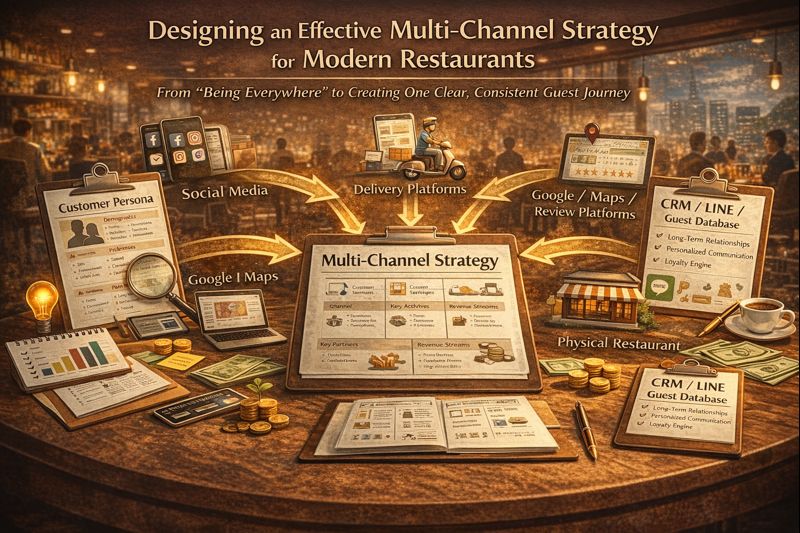
From “Being Everywhere” to Creating One Clear, Consistent Guest Journey
By Charles Tan
Introduction: Guests Are Everywhere—Your Restaurant Must Be One Brand Everywhere
In the past, a restaurant’s primary stage was its physical location.
Today, guests encounter restaurants across multiple touchpoints—often before they ever step inside:
- Social media
- Delivery platforms
- Google Search and Maps
- Review sites
- Websites
- Recommendations from friends
- Walk-by visibility
The challenge is no longer:
“Which channels should we add?”
The real strategic question is:
“Do all the places where guests meet our brand tell the same story and support the same business?”
This is the essence of a modern Multi-Channel Strategy—not expansion, but alignment.
- Rethinking Multi-Channel Strategy in the Restaurant Business
A true multi-channel strategy does not mean being present on every platform available.
It means intentionally designing the role of each channel so they work together toward a common objective.
Many restaurants operate across multiple channels, yet experience:
- Conflicting brand messages
- Inconsistent menus and pricing
- Promotion-driven confusion
- Operational strain on teams
When channels compete instead of complementing one another, complexity increases while profitability declines.
Effective multi-channel strategy is not about volume—it is about coherence.
- Start with Customer Persona, Not Platforms
Strong multi-channel design never begins with technology.
It begins with Customer Persona—a clear understanding of how the target guest lives, decides, and chooses restaurants.
Key questions include:
- How does this guest discover new restaurants?
- Which channels influence their decision most?
- What reassures them before choosing?
- What brings them back?
For example:
- Urban professionals rely heavily on search, reviews, and convenience
- Younger guests engage through social storytelling and visual identity
- Families prioritize trust, clarity, and repeat familiarity
- Tourists depend on reviews, images, and authenticity
When the persona is clear, channels become a mapped decision journey, not a marketing checklist.
- Defining the Role of Each Channel
A successful multi-channel strategy assigns a specific function to each channel.
Physical Restaurant (On-Premise)
This is the heart of the brand experience.
- Food quality
- Service standards
- Atmosphere
- Consistency
The restaurant must deliver on every promise made elsewhere.
Social Media
Not primarily a sales channel—but a brand-building space.
- Express personality and values
- Share stories and behind-the-scenes moments
- Create emotional connection
Social media gives the brand a human voice.
Delivery Platforms
Delivery is not an add-on—it is effectively another branch of the restaurant.
- Menus must be designed specifically for delivery
- Pricing and cost structures must be realistic
- Brand experience must remain intact, even without the dining room
Poorly designed delivery strategies often erode margins silently.
Google, Maps, and Review Platforms
These are decision checkpoints.
- Accurate information
- Real photos
- Consistent reviews
Guests may discover the brand elsewhere—but often finalize decisions here.
CRM, LINE, and Guest Databases
These channels build long-term relationships.
- Encouraging repeat visits
- Personalized communication
- Lower marketing dependency over time
This is where loyalty becomes sustainable.
- Embedding Multi-Channel Strategy into the Business Model Canvas
Multi-channel strategy must be built into the Business Model Canvas, not layered on afterward.
Key areas affected include:
- Channels
- Customer Relationships
- Revenue Streams
- Cost Structure
- Key Activities
The strategic question is always:
“Does this channel create value—or hidden cost—for the business?”
High-performing restaurants select channels that reinforce their USP and Customer Persona, rather than following trends.
- One Brand, One Experience—Across All Channels
The success of a multi-channel strategy is not measured by channel count.
It is measured by whether guests feel:
“No matter where I encounter this restaurant, it feels like the same brand.”
When:
- Visual identity
- Tone of voice
- Pricing logic
- Service philosophy
- Quality standards
are aligned, channels amplify one another instead of creating friction.
- Sustainability: Designing Channels That Teams Can Sustain
Adding channels often increases pressure on people and systems.
A sustainable multi-channel strategy:
- Redesigns workflows
- Chooses channels intentionally
- Avoids exhausting teams for short-term growth
Restaurants that endure choose fewer, clearer, better-managed channels rather than uncontrolled expansion.
Conclusion: Multi-Channel Strategy Is a Business Strategy
An effective multi-channel strategy is not about being visible everywhere.
It is about being present where it matters most, in ways the organization can execute consistently.
When Customer Persona, Unique Selling Point, and Business Model Canvas are aligned,
multi-channel strategy becomes a growth engine—not a burden.
In today’s competitive landscape, clarity outperforms noise.
And consistency builds trust faster than reach.