Building Long-Term Resilience in the Restaurant Business through a Systems Perspective
(A Vigor Perspective)
Introduction
The restaurant industry is widely recognized as one of the most competitive and operationally fragile sectors in the service economy. Volatile food costs, labor shortages, shifting consumer behavior, and increasing pressure from digital platforms have transformed sustainability from a conceptual ideal into a practical requirement for survival.
From an academic standpoint, business sustainability does not simply mean rapid growth or short-term profitability. Rather, it refers to the ability of a business system to maintain balance over time—between revenue and cost, demand and capacity, people and processes, and stakeholder expectations.
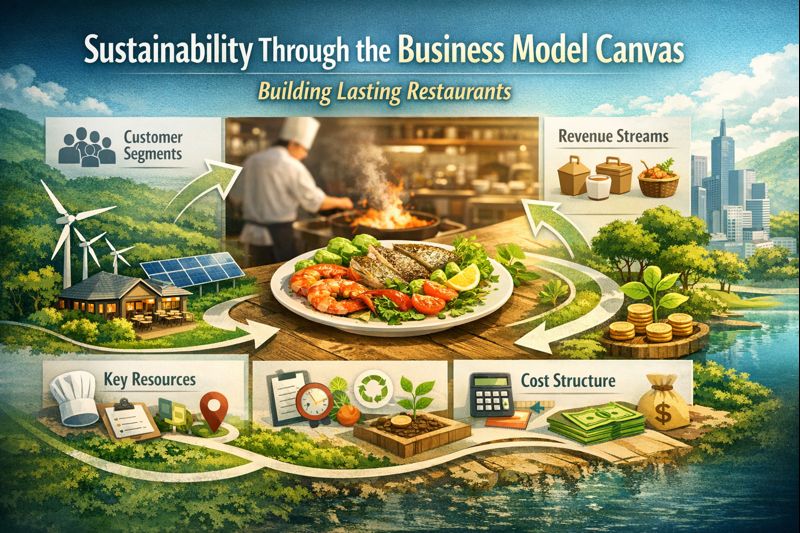
This article explores how Sustainability can be meaningfully integrated into the Business Model Canvas (BMC)—a globally recognized framework for understanding how businesses create, deliver, and capture value. Using the restaurant business as its context, the discussion adopts a systems-based perspective aligned with the Vigor philosophy: precision in design, and deep respect for the realities of service operations.
The Business Model Canvas as a Systems Framework for Restaurants
The Business Model Canvas represents a business through nine interrelated building blocks, encompassing customers, value creation, revenue mechanisms, resources, operations, partnerships, and cost structures. These elements do not operate independently; they function as a single, interconnected system.
In the restaurant industry, operational success or failure rarely stems from a single weakness. More often, it arises from misalignment across the system—for example, a menu designed to attract volume without the operational capacity to deliver consistently, or aggressive marketing that creates expectations the service system cannot sustain.
For this reason, the Business Model Canvas is particularly well suited as a framework for sustainability analysis. It enables managers and executives to trace the long-term implications of everyday operational decisions and to understand how short-term actions shape long-term resilience.
Embedding Sustainability within the Nine Building Blocks of the Business Model Canvas
- Customer Segments
Sustainability begins with serving the right customers. Attempting to cater to every possible segment often leads to operational complexity, rising costs, and diluted service quality. From a systems perspective, long-term viability is strengthened by clearly defined customer segments that the restaurant can serve consistently and profitably.
- Value Proposition
A sustainable value proposition is not defined by novelty alone, but by repeatability. Long-term success depends on the restaurant’s ability to deliver its promised experience consistently—without overstretching its people, processes, or infrastructure. Sustainability emerges when what is promised aligns with what the system can reliably deliver.
- Channels
Sustainable channels are those that reflect reality rather than aspiration. Communication, branding, and distribution must accurately represent the guest experience. Overpromising may drive short-term traffic, but it often generates hidden costs in service recovery, reputational damage, and operational stress.
- Customer Relationships
From a service economics perspective, retaining existing customers is significantly more cost-effective than continuously acquiring new ones. Long-term customer relationships stabilize revenue, reduce marketing costs, and provide ongoing feedback that strengthens operational systems. Loyal guests are not merely a revenue source; they are a stabilizing force within the business model.
- Revenue Streams
Sustainable revenue models are diversified and balanced. Overreliance on a single revenue stream—such as dine-in traffic or a narrow time window—exposes the business to market volatility. Resilient restaurant models design revenue streams that support both profitability and stability over time.
- Key Resources
Sustainable resources are those that can be developed, transferred, and renewed. While talent is critical, long-term resilience depends on systems, standards, and institutional knowledge rather than dependence on specific individuals. A sustainable restaurant is one that continues to function effectively despite staff turnover or organizational change.
- Key Activities
Consistency in core activities—quality control, cost management, inventory discipline, and team leadership—is the operational foundation of sustainability. Reactive problem-solving may resolve immediate issues, but sustainable performance is achieved through disciplined execution of fundamental processes every day.
- Key Partners
Strategic partnerships contribute directly to long-term stability. Suppliers and service partners who share compatible values and planning horizons reduce risk across the supply chain. In sustainable systems, partnerships are evaluated not solely on price, but on reliability, alignment, and mutual resilience.
- Cost Structure
A deep understanding of cost structure is essential to sustainable management. Waste reduction, yield control, and efficient resource utilization are not merely cost-saving measures; they reflect the overall quality of system design. In academic terms, sustainability is closely tied to operational efficiency and loss prevention.
Conclusion
When viewed holistically, sustainability in the restaurant business is not an additional initiative, but the natural outcome of a well-designed and well-managed business model. The Business Model Canvas provides a clear and practical framework for understanding how daily operational decisions accumulate into long-term outcomes.
From a Vigor perspective, sustainability is not achieved through complexity, but through clarity. When systems are designed with precision and managed with a deep understanding of service realities, restaurants are better equipped to remain profitable, adaptable, and resilient over time. True sustainability emerges when operational discipline and human-centered service are brought into lasting alignment.