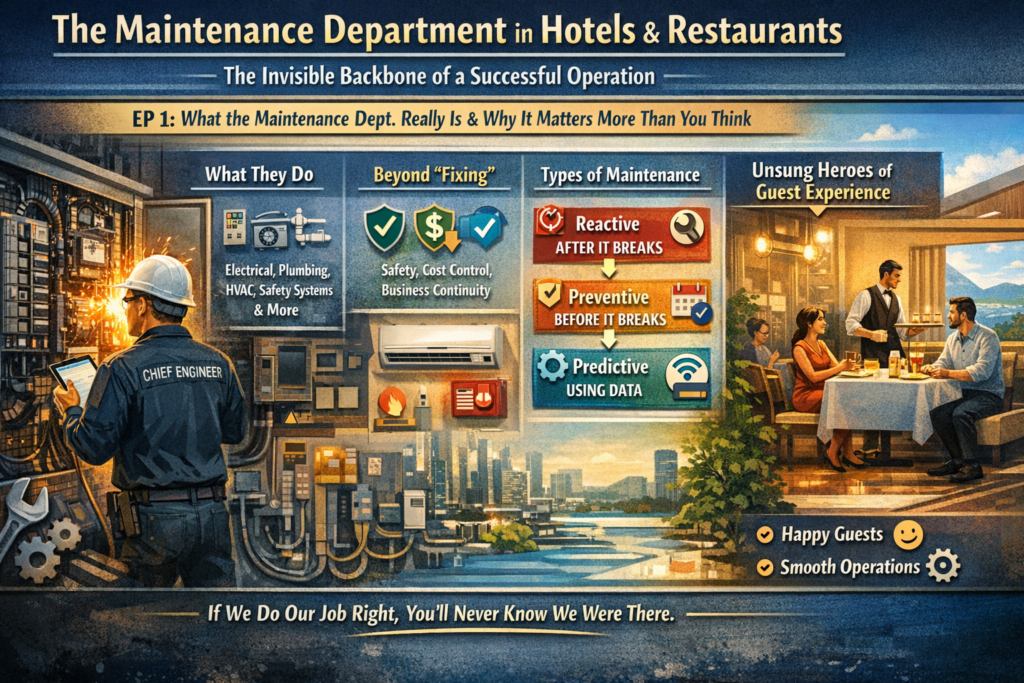
The Invisible Backbone of a Successful Operation
EP 1
What the Maintenance Department Really Is – and Why It Matters More Than You Think
By Charles Tan
Introduction
When people think about a great hotel or restaurant, they usually think of:
- Beautiful rooms
- Delicious food
- Warm and attentive service
But behind all of these visible experiences lies a department that quietly keeps everything running — the Maintenance (or Engineering) Department.
If Front Office is the face of the hotel,
Maintenance is the structure that keeps the building standing.
- What Does the Maintenance Department Do? (Simply Explained)
In the most straightforward terms:
The Maintenance Department is responsible for every system that allows a hotel or restaurant to operate safely, smoothly, and continuously.
Core systems under Maintenance care:
- Electrical systems (lighting, power supply, emergency power)
- Water supply and drainage
- Air-conditioning and ventilation
- Kitchen equipment and gas systems
- Elevators and escalators
- Fire safety systems (fire alarm, fire pumps, sprinklers)
- General building works (doors, floors, walls, roofs)
💡 If one critical system fails, the guest experience collapses instantly.
- The Role of Maintenance from a Management Perspective
Traditionally, maintenance was viewed as:
“Fix it when it breaks.”
In modern hotel and restaurant management, this mindset is outdated.
Today, Maintenance is a preventive and strategic function, not a reactive one.
Four key responsibilities of modern Maintenance:
1) Business Continuity
Hotels and restaurants cannot simply “close for repairs.”
Maintenance ensures operations continue without interruption.
2) Safety & Compliance
Guest and employee safety depends on systems most people never see.
Fire safety, electrical stability, and structural integrity are non-negotiable.
3) Cost Control
Preventing breakdowns is always cheaper than emergency repairs.
Well-maintained assets last longer and cost less over time.
4) Brand Experience
A room that is not cool, a shower with no pressure, or a kitchen shutdown
can damage a brand faster than any marketing campaign can repair.
- Types of Maintenance – Explained Without Technical Jargon
Reactive Maintenance
Fixing things after they break
- Air-conditioner stops working
- Power outage occurs
❌ High risk
❌ High stress
❌ High cost
Preventive Maintenance (PM)
Maintaining systems before failure
- Regular air-conditioner cleaning
- Scheduled pump inspections
- Routine electrical checks
✅ Industry standard
✅ Predictable cost
✅ Reduced downtime
Predictive Maintenance (Modern Approach)
Using data to anticipate failure
- Monitoring operating hours
- Analyzing usage patterns
- Using sensors and maintenance software
✅ Minimal disruption
✅ Accurate budgeting
✅ Strategic asset management
- Typical Maintenance Team Structure
Small to Medium Properties
- Maintenance Supervisor / Chief Engineer
- Multi-skilled Technicians
Large Hotels & Resorts
- Chief Engineer
- Assistant Chief Engineer
- Electrical / Mechanical / Civil Specialists
- Technicians by discipline
💡 Modern insight:
A good technician today must communicate clearly — not just fix equipment.
- Common Misconceptions About Maintenance
❌ “Maintenance is a cost center.”
✅ Maintenance is a long-term cost-saving engine.
❌ “Maintenance has nothing to do with guest experience.”
✅ Maintenance is the silent service team behind every positive review.
EP 1 Summary
The Maintenance Department is not simply a back-of-house function.
It is the structural foundation of hotel and restaurant operations.
When Maintenance works perfectly, guests never notice it.
And that is the highest level of success.