Closing the Gap That Determines Hotel Business Value
By Charles Tan, Vigor Hotel Solutions
Precision with Soul
From Marketing Promise to Guest Reality
Closing the Gap That Determines Hotel Business Value
By Charles Tan, Vigor Hotel Solutions
Precision with Soul
Executive Perspective
In today’s hotel industry, growth is no longer driven by location, brand name, or room count alone. The real differentiator lies in how accurately a hotel aligns its marketing promise with the actual guest experience.
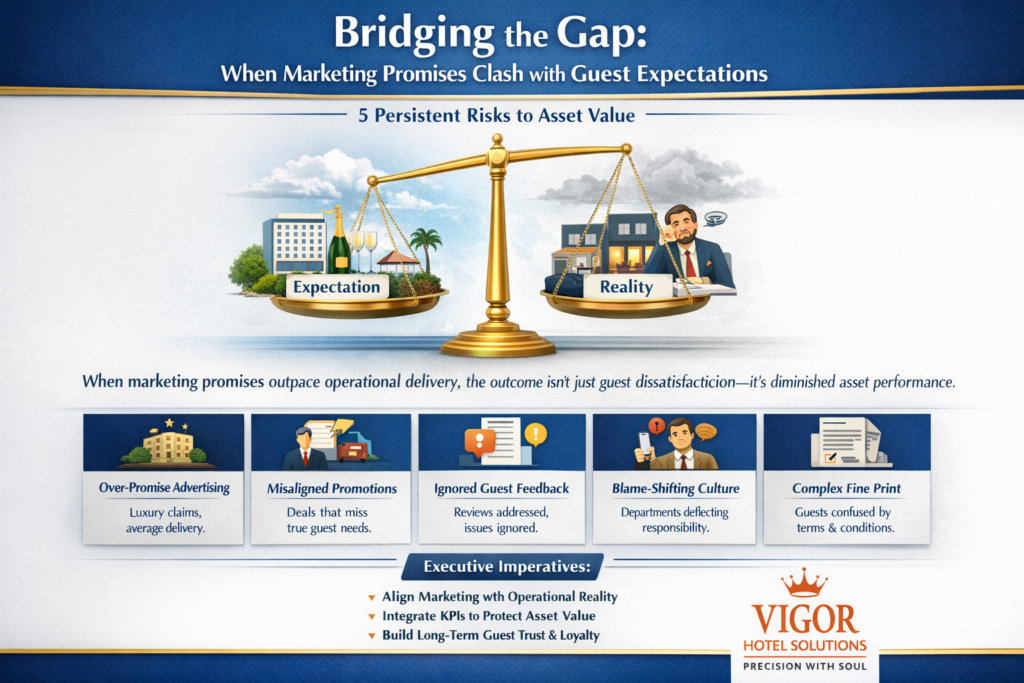
Across markets, we consistently observe the same structural issue: marketing strategies are developed in isolation, while operational realities are expected to “catch up.” The result is not merely dissatisfied guests—but weakened brand equity, unstable demand quality, and long-term value erosion.
At Vigor Hotel Solutions, we view this gap not as a communication flaw, but as a leadership and governance issue—one that directly impacts revenue quality, asset performance, and investor confidence.
- Premium Branding Without Premium Delivery
What the Market Sees
Hotels position themselves using terms such as Luxury, Exclusive, or Five-Star Experience, supported by highly curated visuals and aspirational storytelling.
What Guests Experience
Operationally adequate—but emotionally ordinary—service delivery, often constrained by cost controls, staffing limitations, or legacy systems.
Strategic Risk
Expectation inflation leads to accelerated dissatisfaction. Even when service quality is acceptable, perceived underperformance drives negative reviews and weakens pricing power.
Executive Insight
Luxury is not a design decision—it is an operational commitment. Without governance linking brand language to service capability, marketing success becomes a liability.
- Promotions That Drive Volume, Not Value
What Management Approves
Price-led campaigns, seasonal discounts, and generic value adds designed to boost occupancy or short-term cash flow.
What Guests Actually Need
Segment-specific solutions: reliability for business travelers, safety and space for families, simplicity for international guests.
Strategic Risk
Hotels attract price-sensitive demand without increasing loyalty or lifetime value, resulting in volatile revenue and constant promotional dependency.
Executive Insight
Discounting without insight dilutes brand equity. Sustainable growth comes from relevance—not generosity.
- Guest Feedback Treated as Public Relations, Not Intelligence
Common Practice
Reviews and complaints are managed by marketing teams as reputation control rather than strategic data.
Missed Opportunity
Recurring feedback highlighting mismatches between promise and reality rarely informs future campaign design or operational investment.
Strategic Risk
The same complaints reappear, eroding trust and signaling weak learning capability to the market.
Executive Insight
Guest feedback is a leading indicator of asset health. Ignoring it is equivalent to ignoring early warning signals in financial reporting.
- Fragmented Accountability for the Guest Experience
Operational Reality
When guests raise issues, responsibility is fragmented:
- Operations cite marketing promises
- Marketing defers to front-line execution
Guest Perception
A lack of ownership is interpreted as a lack of care.
Strategic Risk
Trust loss escalates rapidly and is difficult to recover, particularly in high-value segments.
Executive Insight
Customer Experience requires an owner at the leadership level. Without one, excellence becomes accidental rather than intentional.
- Complexity Disguised as Transparency
What Hotels Communicate
Lengthy terms, exclusions, and conditions designed primarily for risk mitigation.
What Guests Feel
Confusion, hesitation, and ultimately disengagement.
Strategic Risk
Booking abandonment and post-purchase dissatisfaction increase—both costly outcomes rarely captured in standard KPIs.
Executive Insight
Clarity is a commercial advantage. If a guest cannot easily understand an offer, they cannot confidently commit to it.
Leadership Conclusion: Why This Matters to Investors
Hotels that fail to align marketing and operations suffer from:
- Weak brand credibility
- High revenue volatility
- Poor repeat business
- Overreliance on discount-driven demand
Conversely, hotels that govern this alignment effectively benefit from:
- Stronger pricing integrity
- Higher guest lifetime value
- Lower reputational risk
- More predictable cash flows
At Vigor Hotel Solutions, we work with owners, boards, and executive teams to bridge this gap—transforming marketing from a sales function into a value assurance mechanism, and operations from a cost center into a brand delivery system.
Sustainable hotel performance is not about selling more promises.
It is about delivering fewer promises—exceptionally well.