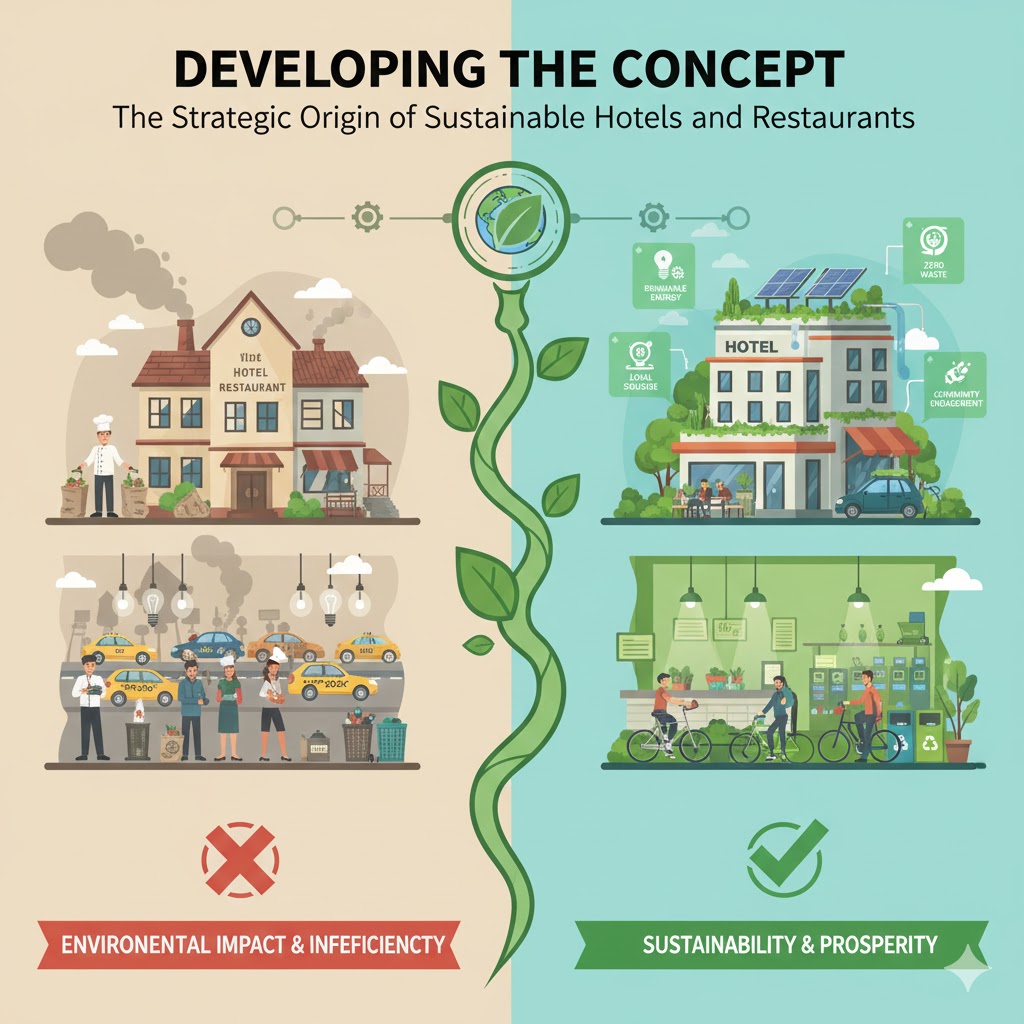
The Strategic Origin of Sustainable Hotels and Restaurants
By Charles tan
Introduction: Great Businesses Do Not Begin with Construction
In Thailand’s hospitality and restaurant sector,
many projects are launched with strong capital, attractive designs, and prime locations —
yet fail to achieve their intended commercial performance.
From our experience at Vigor Hotel Solutions,
this underperformance rarely originates in operations or marketing.
It begins much earlier — at the concept development stage.
A concept is not an aesthetic choice.
It is a strategic decision that shapes every commercial, operational, and experiential outcome that follows.
Concept Development: A Business Discipline, Not a Creative Exercise
In executive terms, a concept is not defined by theme, décor, or branding language alone.
A true hospitality concept answers four fundamental business questions:
- Who is the business designed for?
- Why will guests choose it over alternatives?
- How will it operate consistently and efficiently?
- How will it generate sustainable returns?
When these questions are not clearly resolved,
even the most visually compelling projects struggle to perform.
Why Concept Development Is Critical in the Thai Market
Thailand’s hospitality environment presents unique challenges:
- Highly competitive supply across all segments
- Rapidly evolving consumer behaviour
- Increasing labour and operating costs
- Immediate market feedback through digital platforms
In this context, an unclear or poorly defined concept leads to:
- Overdesigned but underperforming assets
- Operational complexity that erodes margins
- Inconsistent guest experiences
- Reduced investor confidence over time
A strong concept acts as a stabilising framework —
aligning vision, execution, and financial reality.
The Vigor Hotel Solutions Concept Development Framework
- Defining Business Intent
Every successful concept begins with commercial clarity.
We establish:
- Target return on investment
- Payback expectations
- Revenue versus margin priorities
- Long-term asset value versus short-term cash flow
A concept must serve the business strategy — not contradict it.
- Understanding the Target Guest Beyond Demographics
Effective concepts are built on behavioural insight, not assumptions.
Our analysis focuses on:
- Decision-making triggers
- Spending patterns and frequency
- Experience expectations
- Price and service sensitivity
“Tourists” and “local guests” are not homogeneous groups.
Precision in understanding demand is essential to concept strength.
- Strategic Market Positioning
Concept development requires disciplined positioning.
We assess:
- The true competitive set
- Market saturation and gaps
- Opportunities to differentiate without direct confrontation
Failing to choose a position means allowing the market to choose one for you — often unfavourably.
- Designing the Experience, Not Just the Space
At its core, a hospitality concept is an experience blueprint.
We define:
- The guest journey from arrival to departure
- Mood, tone, and emotional impact
- Service style aligned with operational capability
- The balance between efficiency and refinement
Memorable experiences are intentional, not accidental.
- Translating Concept into Operational Reality
A concept only has value if it can be executed consistently.
At Vigor Hotel Solutions, we translate concept into:
- Space planning and layout logic
- Kitchen and back-of-house efficiency
- Menu and service engineering
- Staffing models and workflow
- Technology that supports — not complicates — service
A well-developed concept simplifies operations.
A weak one creates friction and cost.
- Financial Validation and Risk Alignment
Every concept must pass financial scrutiny.
We evaluate:
- Capital expenditure versus revenue potential
- Operating cost sustainability
- Margin resilience under market pressure
- Realistic break-even scenarios
Elegance without economic logic is not a strategy — it is a risk.
Concept Development: Hotels vs Restaurants
Hotels
- Brand positioning and identity
- Facility relevance to target demand
- Service philosophy consistency
- Scalability and long-term adaptability
Restaurants
- Menu focus and complexity
- Table turnover economics
- Kitchen throughput capacity
- Peak-hour profitability
Each segment demands a distinct conceptual discipline.
Executive Insight: Concept Is Leadership
In mature hospitality markets,
competitive advantage is rarely created through design alone.
It is created through:
- Clear strategic intent
- Disciplined decision-making
- Operational honesty
- Financial alignment
A strong concept reduces uncertainty, accelerates execution, and protects investor value.
Conclusion
By Vigor Hotel Solutions
Successful hotels and restaurants are not defined by how they open,
but by how clearly they were conceived.
At Vigor Hotel Solutions,
we believe that enduring hospitality performance begins with conceptual precision
guided by real-world operational understanding.
Precision with Soul
is how ideas become businesses —
and businesses become lasting assets.