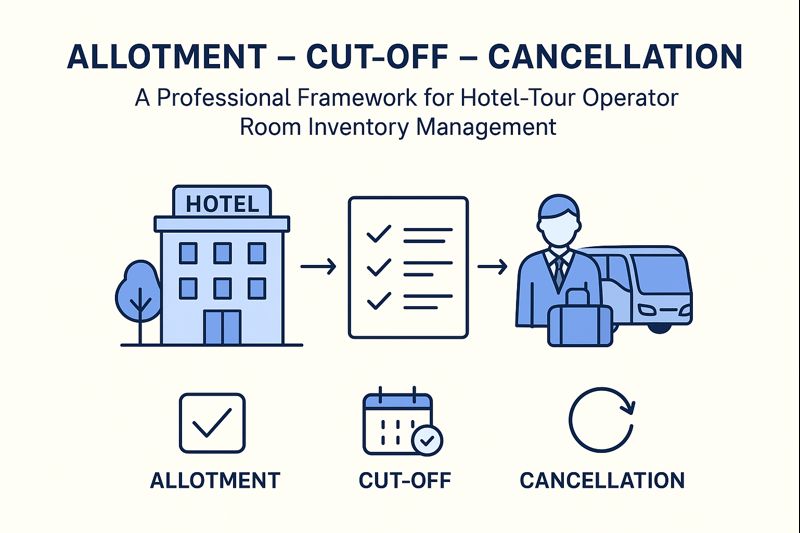
A Professional Framework for Hotel–Tour Operator Room Inventory Management
Introduction
In the modern hospitality landscape, Allotment, Cut-off, and Cancellation are not merely contractual terms; they are strategic revenue management tools. When properly structured and consistently applied, they allow hotels to balance occupancy, pricing integrity, cash flow stability, and long-term partnerships with tour operators.
This article presents a comprehensive, practical, and internationally accepted framework for managing room allotments between hotels and tour operators, tailored specifically to the realities of hotels operating in Thailand.
- What Is Allotment and Why Do Hotels Use It?
Allotment refers to the practice whereby a hotel blocks a predefined number of rooms for a tour operator, wholesaler, DMC, or OTA for a specific period, under agreed commercial and operational conditions.
Key Reasons Hotels Offer Allotment
- Revenue predictability and forward visibility – enabling accurate forecasting and cash-flow planning.
- Occupancy support during low and shoulder seasons – reducing unsold inventory.
- Access to markets the hotel cannot efficiently reach directly, particularly international inbound leisure segments.
- Lower sales and marketing costs compared to direct acquisition.
- Long-term partnership building with reliable distribution partners.
- Controlled inventory allocation aligned with revenue management strategy.
A well-managed allotment program is not a discounting exercise; it is a volume-driven, risk-balanced distribution strategy.
- Types of Allotment
2.1 Non-Guaranteed Allotment
- Rooms are blocked for the partner.
- Rooms must be confirmed before the cut-off date.
- Unused rooms are automatically released back to the hotel without penalty.
Best suited for:
- Normal leisure markets
- Hotels with strong direct sales capability
2.2 Guaranteed Allotment
- The partner assumes full responsibility for the allocated rooms.
- Typically supported by deposits or advance payments.
- Rooms are non-cancellable and non-refundable.
Best suited for:
- Low season risk mitigation
- Large groups, MICE, or contracted series business
2.3 Mixed (Hybrid) Allotment Model – Recommended Best Practice
A combination of guaranteed and non-guaranteed rooms within the same contract.
Benefits:
- Risk sharing between hotel and partner
- Improved flexibility
- Optimized revenue protection
- Cut-off Date: Definition and Application
The cut-off date is the final date and time by which a tour operator must confirm rooms from its allotment.
After the cut-off:
- Any unconfirmed rooms are automatically released back to the hotel.
- The hotel regains full control of the inventory for resale.
Cut-off applies only to unconfirmed rooms and carries no financial penalty.
- Principles for Setting Cut-off Dates
Cut-off periods must be commercially fair and operationally realistic. They should be determined by:
- Seasonality (high, shoulder, low)
- Market booking behavior and lead time
- The hotel’s ability to resell released inventory
- The agreed room rate level
Recommended Cut-off Grid (Thailand Market Practice)
|
Season |
Recommended Cut-off |
|
High / Peak Season |
30–21 days |
|
Shoulder Season |
21–14 days |
|
Low Season |
7–3 days |
|
Festivals / Major Events |
45–60 days |
|
MICE / Large Groups |
90–60 days |
Best Practice: Always apply a rolling cut-off, calculated backwards from the arrival date.
- Cut-off Time
A cut-off is incomplete without a specified time.
Industry standard:
- 17:00–18:00 hrs (hotel local time)
Rooms not confirmed by this time are automatically released.
- Relationship Between Cut-off and Pricing
Longer cut-off periods justify lower net rates. Shorter cut-off periods support higher rates, closer to BAR.
This balance ensures commercial fairness and protects the hotel’s pricing integrity.
- Cancellation: Definition and Applicability
Cancellation refers to the termination of rooms that have already been confirmed.
 Cancellations are permitted ✘ Cancellations are not free
Cancellation applies only after confirmation and is governed by clearly defined deadlines and penalties.
- Cut-off vs. Cancellation (Critical Distinction)
|
Aspect |
Cut-off |
Cancellation |
|
Applies to |
Unconfirmed rooms |
Confirmed rooms |
|
Financial penalty |
None |
Yes |
|
Risk holder |
Hotel |
Tour operator |
- Cancellation Deadlines (Recommended)
|
Season |
Cancellation Deadline |
|
High / Peak Season |
21–14 days |
|
Shoulder Season |
14–7 days |
|
Low Season |
7–3 days |
|
Events / MICE |
60–30 days |
Cancellation deadlines must always be shorter than the cut-off period.
- Cancellation Penalties (Step-Scale Model)
|
Cancellation Timing |
Penalty |
|
Before deadline |
No charge |
|
21–14 days |
30% |
|
13–7 days |
50% |
|
6–3 days |
75% |
|
0–2 days / No-show |
100% |
Penalties are calculated based on: Net room rate × number of rooms × number of nights
- Guaranteed Allotment and Cancellation
- Guaranteed allotments are non-cancellable and non-refundable.
- 100% cancellation penalty applies.
- Exceptions may apply only in cases of force majeure or where rooms are successfully resold (if contractually agreed).
- Partial Cancellation and Shortfall
- Partial cancellation may be permitted before the cancellation deadline.
- Typically limited to 20–30% of the total allotment.
- Excess cancellation is treated as shortfall and penalized accordingly.
- Deposits and Payment Treatment
|
Scenario |
Standard Practice |
|
Cancellation before deadline |
Refund or credit |
|
Cancellation after deadline |
Deposit forfeited |
|
Guaranteed allotment |
Non-refundable |
Clear wording in contracts is essential.
- Force Majeure
Force majeure clauses should cover events such as:
- Natural disasters
- Pandemics
- Government travel restrictions
- Airspace or border closures
Standard approach:
- Cancellation without penalty
- Deposits converted into future credit
- Common Mistakes in Hotel Practice
- Applying one policy year-round
- Confusing cut-off with cancellation
- Granting excessive flexibility without revenue approval
- Failing to monitor pickup performance
- Operating without written SOPs
- Best Practices for Hotel Management
- All allotments must be approved by Revenue Management.
- Use seasonal cut-off and cancellation grids.
- Link rate levels directly to cut-off flexibility.
- Require deposits for guaranteed business.
- Ensure all terms are contractually documented.
- Review performance quarterly and adjust strategy accordingly.
Executive Summary
Allotment, cut-off, and cancellation policies are fundamental instruments of professional hotel revenue management. When clearly structured and consistently enforced, they:
- Protect hotel revenue
- Reduce operational risk
- Strengthen partner relationships
- Support sustainable long-term profitability
Hotels that manage these systems strategically gain control over their inventory. Hotels that do not inevitably lose revenue—often without realizing it.