ฺBy Charles Tan
Executive Summary
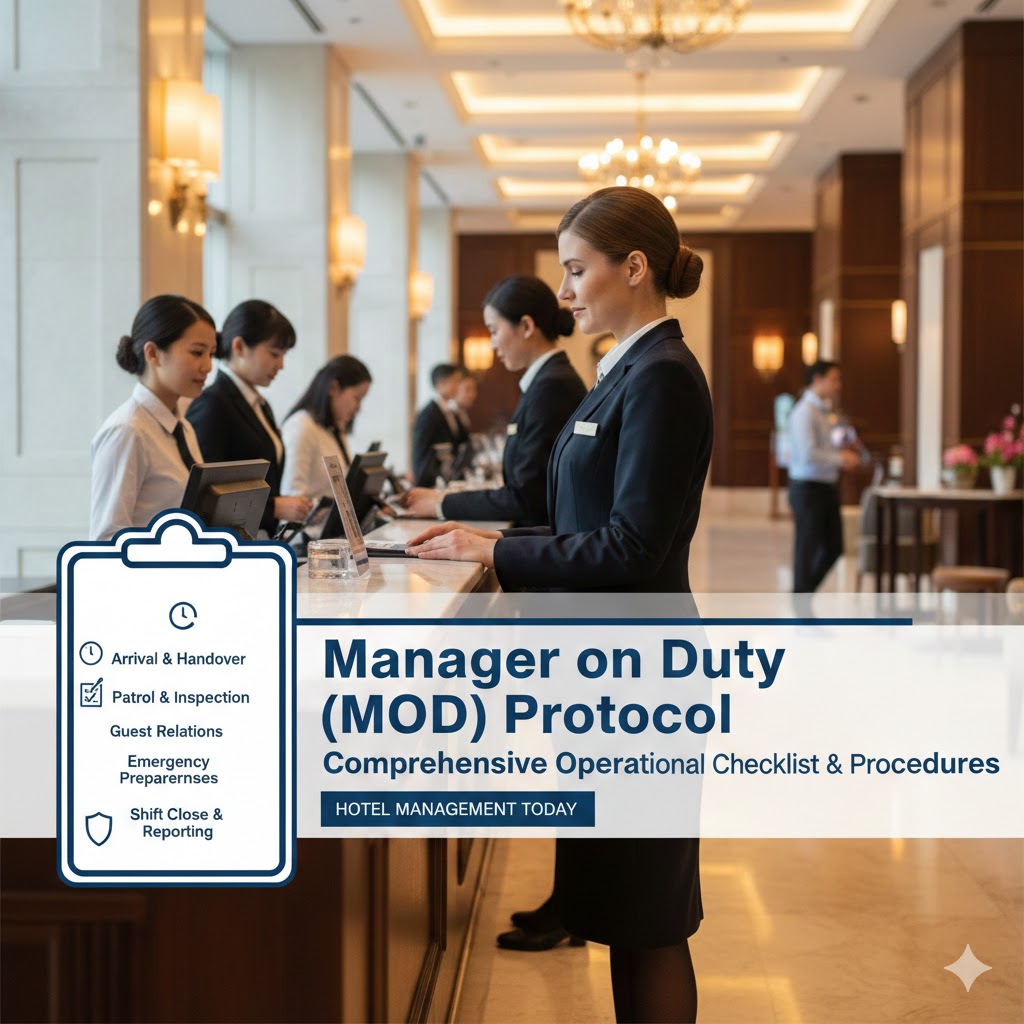
The Manager on Duty (MOD) is the designated senior authority and operational commander onsite during an assigned shift. This role requires continuous physical presence within the property, full responsibility for all departments, and the delegated authority to make critical decisions to ensure seamless service, safety, and compliance with brand standards.
Departmental Coordination & Direct Oversight
The MOD must maintain constant readiness to interface with and direct the following core departments:
- Front Office: Primary command center for guest flow, emergencies, and service recovery decisions.
- Food & Beverage (F&B): Direct oversight during peak service periods in all outlets (restaurants, bars, banquets, room service).
- Housekeeping: Final authority on room readiness, urgent cleaning issues, and VIP accommodations.
- Engineering & Security: Serves as the Incident Commander for all safety, security, maintenance, and medical emergencies, requiring immediate availability.
Shift Structure & Compensation
Shift Patterns & Residence Requirements
- 24/7 Dedicated MOD: (Large Hotels)
- Shifts: Typically 8-12 hours (AM: 0700-1600 | PM: 1500-2400 | Overnight: 2300-0800).
- Residence: Mandatory stay in a dedicated MOD room provided by the property, especially for overnight and back-to-back shifts.
- On-Call MOD: (Mid-size/Boutique Properties)
- On-site until core operations end (e.g., 2200), then on-call for emergencies.
- Must be able to return to the property within 30 minutes of notification.
- Rotational MOD: (Management Team Rotation)
- Managers rotate MOD duties weekly or as scheduled.
- During MOD shift, routine administrative duties are minimized to focus on operational oversight.
MOD Allowances & Benefits
- MOD Allowance: A fixed per-shift premium paid on top of base salary (varies by property tier).
- Transportation Allowance: Provided for commuting during unsocial hours (e.g., after midnight).
- On-Duty Meals: Complimentary meals from staff or outlet kitchens during the shift.
- Accommodation: Use of a designated MOD room for rest periods during shifts exceeding 12 hours or overnight.
- Emergency Expense Authority: Pre-approved spending limit for urgent guest or operational issues.
- Decision-Making Authority: Empowerment to approve discounts, compensation, and upgrades within predefined limits.
Detailed MOD Operational Checklist
- Front Desk & Reception Audit (Conducted at Shift Start & Periodically)
- Key Performance Inquiry:
- Current Occupancy Percentage and forecast for the next 24 hours.
- Expected Arrival/Departure Counts, including any groups.
- VIP Status: In-house VIPs, expected VIP arrivals, and their specific requirements.
- Group Movement: All group check-ins/outs, meal vouchers, and itinerary coordination.
- Room Status: Number of Out-of-Order (OOO) rooms and expected return-to-inventory timeline.
- Potential Issues: Any problematic reservations, credit issues, or special requests.
- Food & Beverage Outlet Inspection
- Per Outlet Check:
- Covers: Guest count per meal period (Breakfast, Lunch, Dinner).
- Reservations: Bookings list and corresponding table/station assignments.
- Daily Specials: Verification of promoted items and ingredient availability.
- Function Space Check:
- Event Schedule: All banquet/meeting events (name, organizer, Pax count).
- Event VIPs: Any high-profile attendees and their protocols.
- Setup & Readiness: Room setup, AV functionality, and catering timeline.
- Service Quality Test:
- Place a Test Order: Order standard menu items to evaluate order-to-delivery time, plate presentation, and correct temperature.
- Guest Interaction: Conduct table visits to at least two occupied tables for direct feedback.
- Random Guest Room Inspection (Minimum 2-3 Rooms per Shift)
- Procedure: Inspect a mix of clean vacant rooms and recently vacated rooms.
- Inspection Criteria:
- General Cleanliness: Floors, walls, ceilings, windows.
- Equipment Functionality:
- HVAC (correct temperature, quiet operation)
- Television & entertainment systems
- All lighting fixtures (including bedside and bathroom)
- Tea/Coffee station (fully stocked, clean)
- In-room safe
- Bathroom:
- Water pressure and correct hot/cold temperature mix.
- Amenities fully stocked and fixtures spotless.
- Minibar:
- Stock levels match par stock list.
- All items within expiry date.
- Refrigerator at correct temperature (typically 5°C / 41°F).
- Consumption charges properly logged.
- Additional Amenities: Bathrobes, slippers, emergency flashlight.
- Safety, Security & Back-of-House Audit
- Parking & Perimeter:
- Traffic flow and lot organization.
- Security patrol presence and visibility.
- Security Department:
- Review Security Log for incidents.
- CCTV Check: Verify cameras are operational, lenses clean, and recordings active for critical areas (front drive, lobbies, back entrances).
- Life Safety Systems:
- Fire Exits: All must be unobstructed, self-closing, and open freely.
- Exit Signs: Illuminated and visible.
- Fire Extinguishers: In designated locations, seals intact, inspection tag current.
- Fire Alarm Panel: Check for any trouble signals or recent activations.
- Kitchen & Food Production Area Inspection (All Kitchens)
- Critical Control Points:
- Refrigeration/Freezer Temperatures: Document actual temps. (Chillers: ≤5°C/41°F, Freezers: ≤-18°C/0°F).
- FIFO Compliance: Verify date labeling and stock rotation.
- Staff Hygiene: Proper uniform, hair restraints, glove use.
- General Cleanliness: Floors, walls, equipment free of grease/debris.
- Pest Control: No signs of infestation; traps are in place and monitored.
- Garbage/Recycling Area:
- Proper waste segregation.
- No odor nuisance; dumpster lids closed.
- Area clean and scheduled for pickup.
- Room Service System Test
- Call Test: Time how many rings before the order is answered. Evaluate phone etiquette.
- Order Process: Assess staff’s product knowledge and upselling technique.
- Delivery Timing: Clock the interval from order placement to door knock.
- Service Standards: Check trolley cleanliness, food presentation, temperature, and correct billing.
- Trolley Retrieval: Verify timely collection of trolleys from guest corridors.
- Additional Spot Checks
- Pool & Fitness Center: Cleanliness, chemical levels (if trained), equipment order, proper signage.
- Hotel Shops: Open/close on time, staff presentation.
- Front Drive: Bell staff efficiency, traffic management, guest assistance.
- IT/Systems: Test one guest internet login, inquire about in-room entertainment or key card issues.
- Staff Visibility: Spot-check employee grooming, name tag use, and greeting protocol in various departments.
Post-Inspection Protocol & Reporting
- Log Entries: Document all findings, actions taken, and follow-ups required in the MOD Log Book.
- Issue Categorization:
- Category 1 (Resolved): Issues corrected immediately by MOD.
- Category 2 (Delegated): Issues assigned to a department head with a clear deadline.
- Category 3 (Escalated): Critical issues requiring senior management awareness/action.
- Photographic Evidence: Take photos of any major defects or non-compliance for documentation.
- Shift Handover: Conduct a formal verbal and written briefing with the incoming MOD, highlighting pending issues and recent events.
- Management Report: Submit a concise summary report to the General Manager/Resident Manager at the end of the shift cycle.
Conclusion
The MOD role is the cornerstone of operational integrity. It transcends passive observation, requiring proactive, systematic verification using this comprehensive checklist. By physically inspecting, testing systems, and engaging with both staff and guests, the MOD acts as the property’s primary quality control agent and first responder, preventing issues and safeguarding the guest experience, ultimately protecting the brand’s reputation and financial performance.