By Charles
Executive Overview
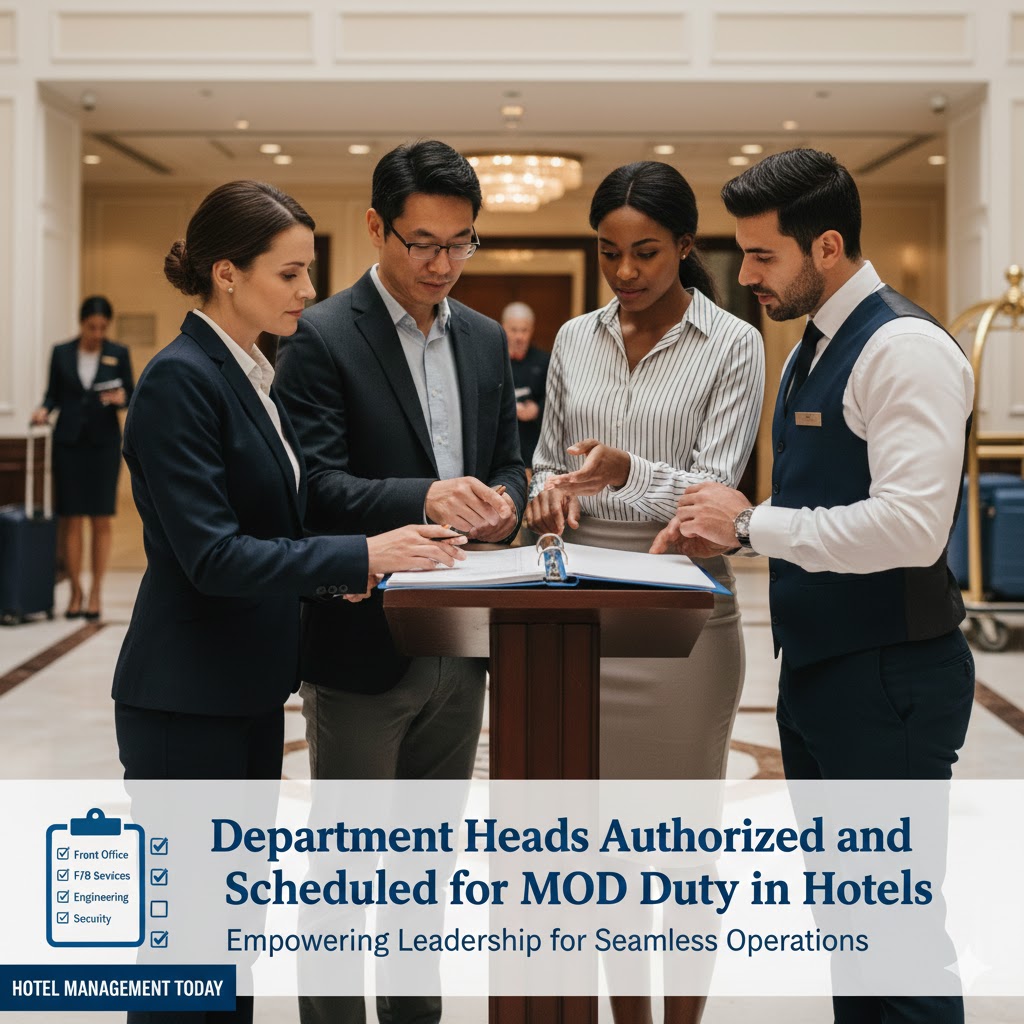
In professional hotel operations, the Manager on Duty (MOD) responsibility is typically rotated among qualified department heads. This practice fosters cross-departmental understanding, develops executive leadership skills within the management team, and ensures consistent, authoritative oversight during all operational hours.
- Primary Department Heads (Mandatory MOD Rotation)
- Senior Management Tier
✔ General Manager / Hotel Manager
- Role: Ultimately responsible for the MOD program’s effectiveness. May serve as the MOD during critical periods or in the absence of other senior leaders.
- Frequency: As needed; sets the standard for MOD performance.
✔ Front Office Manager / Director of Rooms
- Rationale: Possesses the most comprehensive, real-time operational data and has direct daily guest interaction.
- Core MOD Skills: Mastery of PMS, guest recovery protocols, and overall operational coordination.
- Frequency: High (e.g., 1-2 scheduled shifts per week).
✔ Food & Beverage Manager / Director of F&B
- Rationale: Oversees the largest revenue centers and areas with high guest volume and potential for critical incidents.
- Core MOD Skills: Command of kitchen safety, banquet operations, and outlet service standards.
- Frequency: High (e.g., 1 scheduled shift per week).
✔ Executive Housekeeper
- Rationale: Responsible for the hotel’s core product (guest rooms) and often the largest workforce.
- Core MOD Skills: Deep quality assurance knowledge, logistical planning for room readiness, and staff management.
- Frequency: Regular (e.g., 1 shift every other week).
- Supporting Department Heads (Strongly Recommended for MOD Duty)
- Operational & Technical Leadership
✔ Chief Engineer / Director of Engineering
- Value: Provides immediate, expert decision-making for technical, safety, and facility emergencies.
- Special MOD Focus: Critical system failures, life safety compliance, and contractor oversight.
- Typical Shift: Often scheduled for overnight or weekend MOD duty.
✔ Director of Sales & Marketing / DOSM
- Value: Enhances client relations during their stay and understands the operational impact of group business.
- Special MOD Focus: VIP client interaction, coordination of in-house group events, and service recovery for key accounts.
- Frequency: Moderate (e.g., 1-2 shifts per month).
- Developing Leaders (MOD for Training & Succession Planning)
- Assistant Department Heads & Supervisors
✔ Assistant Front Office Manager / Front Desk Supervisor
- Status: Often the designated MOD for overnight (“Graveyard”) shifts.
- Development Goal: To prepare for future Front Office Manager or Rooms Division leadership roles.
✔ Restaurant Manager / Outlet Manager
- Status: Initially serves as MOD within their outlet, then graduates to hotel-wide MOD duty.
- Development Goal: To broaden perspective beyond F&B to holistic hotel operations.
✔ Housekeeping Supervisor / Floor Manager
- Status: May act as a secondary MOD for room-related issues.
- Development Goal: To develop broader leadership and decision-making skills.
- MOD Rotation Schedule & Authority Matrix
|
Position |
Recommended MOD Frequency |
Typical Decision-Making Authority |
Key Rationale |
|
General Manager |
Ad Hoc / As Required |
Unlimited |
Ultimate oversight & crisis management. |
|
Front Office Manager |
1-2 shifts per week |
High (Comps, upgrades, significant discounts) |
Central operational role with full guest cycle view. |
|
F&B Manager |
1 shift per week |
High (F&B-specific), Moderate (other areas) |
Controls major revenue & risk centers during peak times. |
|
Executive Housekeeper |
1 shift bi-weekly |
Moderate (Focused on quality & staffing) |
Ensures core product integrity and manages largest team. |
|
Chief Engineer |
Scheduled (e.g., weekends/overnights) |
High (Technical/Safety), Moderate (Guest issues) |
Critical for emergency response and system reliability. |
|
Director of Sales |
1-2 shifts per month |
Moderate (Enhanced focus on VIPs/Groups) |
Strengthens client relations and understands group impact. |
- Qualifications & Training for MOD Duty
Mandatory Prerequisites:
- Cross-Functional Knowledge: Demonstrated understanding of all major departments’ basic functions.
- Decision-Making Caliber: Proven ability to make sound judgments under pressure.
- Leadership Presence: Command respect and possess the authority to direct staff from any department.
- Communication Mastery: Ability to interact effectively with guests at all levels and communicate clearly with staff.
- Certification: Must be certified in:
- CPR & First Aid
- Property-specific emergency procedures (fire, bomb threat, natural disaster)
- Alcohol awareness/service training (where applicable)
Formal MOD Training Program:
- Shadowing: Must shadow an experienced MOD for a minimum of 3-5 full shifts.
- Policy Review: Thorough review of MOD logbook, empowerment limits, refund/compensation authority, and legal liabilities.
- Scenario Drills: Participation in simulated emergency and high-pressure guest incident scenarios.
- Systems Access: Training on all relevant systems (PMS, POS, Key Card, CCTV access).
- Scheduling & Rotation Systems
Effective Models:
- Fixed Master Rotation:
- A pre-published schedule covering 1-3 months.
- Ensures fair distribution and allows managers to plan their regular duties around MOD shifts.
- Expertise-Based / Shift-Specific Assignment:
- AM MOD: Often Front Office or Housekeeping (focus: check-outs, arrivals, morning operations).
- PM MOD: Often F&B Manager (focus: dinner service, evening events, nightlife).
- Overnight MOD: Often Assistant Manager or Chief Engineer (focus: security, audits, early preparations).
- Back-Up & On-Call Roster:
- Maintain a clear list of 2-3 qualified “Standby MODs” for illness or emergency coverage.
- Defines clear call-in procedures for the on-call MOD.
- Organizational & Individual Benefits
Benefits to the Hotel:
- Faster Resolution: Department-head MODs have the expertise and authority to solve problems immediately.
- Break Down Silos: Fosters empathy and cooperation between departments as managers experience cross-functional challenges.
- Improved Communication: Creates a cadre of managers who understand the “big picture,” improving inter-departmental coordination.
- Succession Planning: Identifies and prepares high-potential leaders for future executive roles (e.g., Resident Manager, GM).
Benefits to the Individual:
- Leadership Development: Provides unmatched experience in holistic property management and crisis leadership.
- Career Capital: Demonstrates readiness for promotion by showcasing ability to handle total operation responsibility.
- Network Building: Builds stronger peer relationships with other department heads.
- Strategic Understanding: Develops a deeper understanding of how all hotel departments interlink to drive profitability and guest satisfaction.
- Role of Department Heads When NOT Serving as MOD
Even when not the MOD, department heads are responsible for:
- Briefing: Proactively informing the active MOD of any planned events, potential issues, or VIPs in their department.
- Supporting: Remaining available as a subject-matter expert for consultation if the MOD encounters a department-specific issue.
- Acting on Feedback: Promptly addressing any operational deficiencies or guest feedback the MOD logged regarding their department.
- Upholding Authority: Publicly supporting the MOD’s decisions to their own staff, reinforcing the chain of command.
Conclusion
Implementing a structured MOD rotation among qualified department heads is a hallmark of a professionally managed hotel. This system ensures expert, authoritative coverage 24/7 while strategically developing the next generation of hotel leaders. It transforms the MOD role from a simple supervisory task into a powerful tool for leadership development, operational excellence, and building a cohesive, cross-functional management team.