A hotel room’s true cost is far more than just cleaning supplies. It’s a complex blend of direct, indirect, and fixed expenses. Understanding these layers is fundamental to pricing, revenue management, and ultimately, profitability.
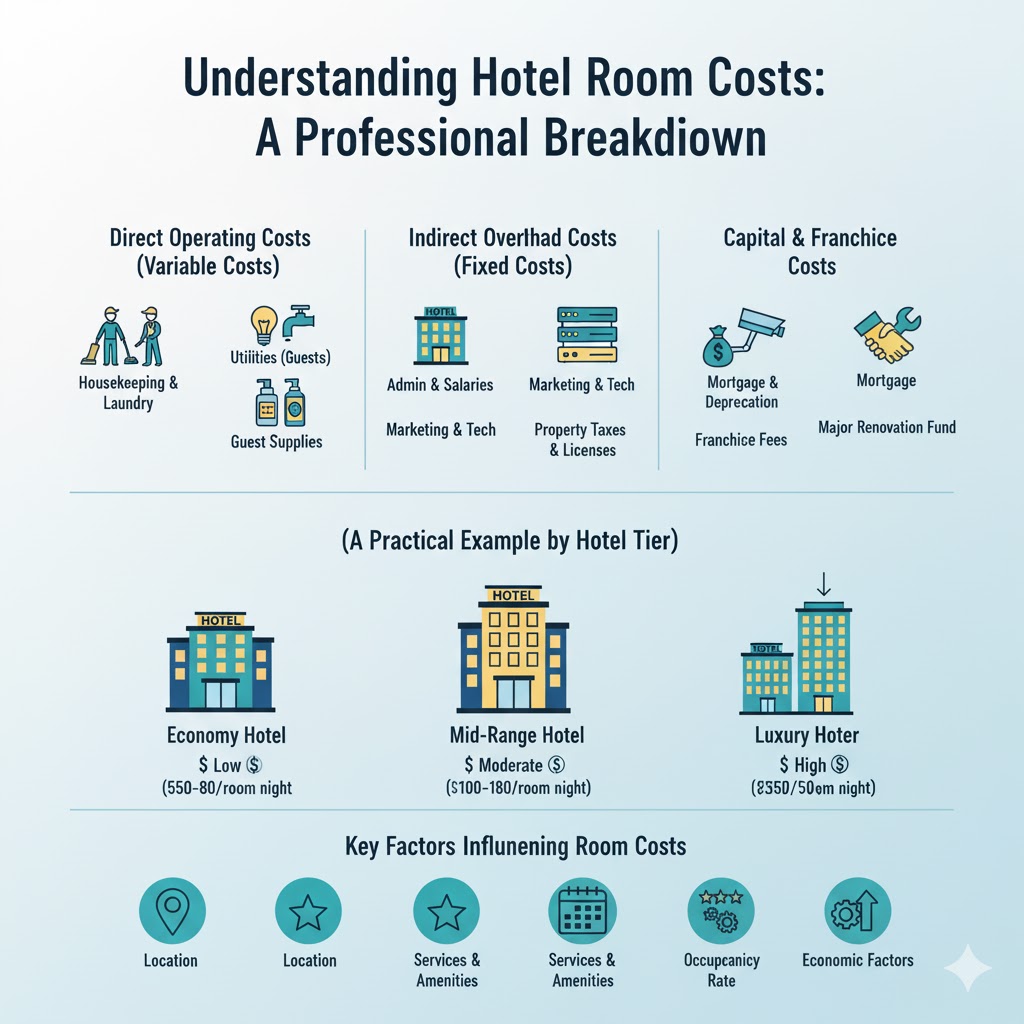
We can categorize room costs into three main layers:
- Direct Operating Costs (Cost per Occupied Room)
- Indirect Overhead Costs (Fixed & Administrative)
- Capital & Franchise Costs (Long-term Investments)
- Direct Operating Costs (Variable Costs)
These are expenses incurred every time a room is sold. They are variable and directly tied to occupancy.
- Housekeeping Labour: Wages, benefits, and incentives for room attendants, inspectors, and supervisors. This is often the largest direct cost.
- Guest Supplies & Amenities:
- Consumables: Soap, shampoo, conditioner, lotion, shower caps, coffee, tea, creamer, sugar, bottled water.
- Disposables: Toilet paper, tissues, liners, cups.
- Linen & Laundry: The cost of washing bed sheets, pillowcases, towels, and bathrobes. This includes detergent, water, energy for machines, and the gradual replacement of worn-out linens.
- Utilities (In-Room): The direct cost of electricity (A/C, lighting), water, and gas used by a guest during their stay.
- Commissions (Distribution Cost): A significant percentage (typically 15-30%) of the room rate paid to Online Travel Agencies (OTAs) like Booking.com and Expedia for each booking they generate.
- Maintenance & Repairs: The cost of minor repairs and preventative maintenance for room fixtures, appliances, and furniture.
- Indirect Overhead Costs (Fixed Costs)
These are the hotel’s general operating expenses. They exist regardless of how many rooms are sold and must be allocated across all available rooms.
- Departmental Labour (Non-Revenue): Salaries for front desk staff, concierge, reservation agents, maintenance engineers, and security.
- Sales, Marketing & Advertising: Costs for digital marketing (SEO/SEM), website maintenance, public relations, promotional campaigns, and the salaries of the sales and marketing team.
- Administrative & General (A&G): Management salaries, office supplies, insurance, legal fees, accounting, bank charges, and corporate expenses.
- Utilities (Common Areas): Electricity, water, and gas for lobbies, hallways, pools, fitness centers, and back-of-house areas.
- Property Operations & Maintenance (POM): General upkeep of the entire property, including landscaping, pool maintenance, and repairs to public areas.
- Capital & Franchise Costs
These are long-term costs related to the initial investment and brand affiliation.
- Depreciation & Amortization: The non-cash expense that allocates the cost of the hotel’s physical assets (building, furniture, fixtures, equipment) over their useful life. This is a huge cost that must be accounted for.
- Franchise Fees: If the hotel is part of a chain, it pays ongoing fees to the parent company, which often include a percentage of gross revenue plus a marketing fee.
- Property Taxes & Insurance: Annual fixed costs associated with owning the asset.
- Debt Service: Mortgage or loan payments if the property is leveraged.
How Hotels Calculate Cost & Set Prices
Hotels don’t use a single “cost.” They use different calculations for different strategic decisions:
- Variable Cost per Occupied Room:
- Formula: Sum of all Direct Operating Costs.
- Strategic Use: This is the absolute minimum price for a last-minute sale. Any price above this contributes to covering fixed costs. Selling below this is losing money on the sale.
- Total Cost per Available Room (Total Cost Per Room):
- Formula: (All Operating Expenses + Overheads + Capital Costs) / Total Number of Available Rooms.
- Strategic Use: This determines the hotel’s Break-Even Point. The average daily rate (ADR) must be higher than this for the hotel to be profitable. This is the true “cost” of having a room available for sale.
- Break-Even Occupancy:
- Formula: (Total Fixed Costs / (Average Daily Rate – Variable Cost per Room)) / Number of Rooms.
- Strategic Use: This tells management the minimum occupancy required to start making a profit. It’s a crucial benchmark for evaluating performance.
A Practical Example by Hotel Tier
Cost Component | Luxury (5-Star) | Upscale (4-Star) | Mid-Market (3-Star) |
Direct/Variable Cost (per stay) | |||
– Housekeeping & Amenities | High (Premium brands, high staff ratio) | Moderate (Good quality, efficient) | Low (Basic brands, refillable dispensers) |
– Example Cost | $80 – $150+ | $40 – $80 | $20 – $40 |
Indirect/Fixed Cost (per room) | |||
– Staff, Utilities, Marketing | Very High (Extensive services, prime location) | High (Full service, good location) | Moderate (Lean staffing, efficient operation) |
– Example Cost | $150 – $300+ | $90 – $180 | $50 – $100 |
Total Cost per Room (Est.) | $230 – $450+ | $130 – $260 | $70 – $140 |
Typical ADR (Average Daily Rate) | $600 – $1,200+ | $250 – $500 | $120 – $220 |
Pricing & Cost Strategy | Experience-Driven: High costs are justified by the premium price of an unparalleled guest experience. Cost control focuses on efficiency, not cheapness. | Value & Balance: Balances a high-quality offering with rigorous cost control. Efficiency in operations is key to maintaining profitability. | Efficiency-Driven: The entire model is built on minimizing both variable and fixed costs. Profit comes from high volume and operational leanness. |
Key Factors Influencing Room Costs
- Hotel Class & Brand: A luxury resort has inherently higher costs than a limited-service economy hotel.
- Location: Labor, real estate, and tax costs vary dramatically by city and country.
- Seasonality: Costs can fluctuate with demand (e.g., higher laundry costs, need for temporary staff).
- Operational Efficiency: Technology, staff training, and smart processes can significantly reduce costs without sacrificing quality.
In essence, mastering room costs is the foundation of Revenue Management. It’s not about knowing what a room costs to clean, but what it costs to own, maintain, market, and sell that room profitably, night after night.