By Charles Tan
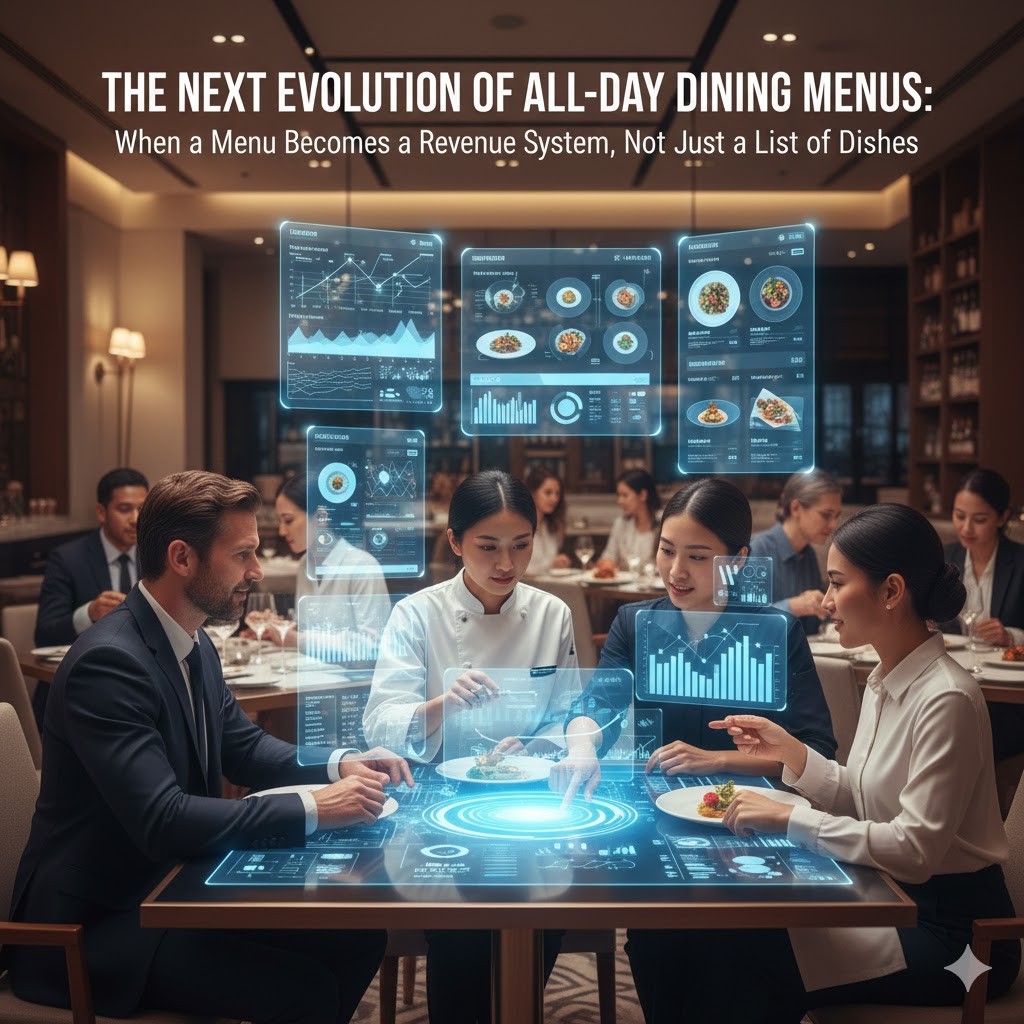
When a Menu Becomes a Revenue System, Not Just a List of Dishes
For years, all-day dining menus in hotels and restaurants have followed a familiar pattern:
long lists, complex ingredients, and pricing designed simply to “cover everything.”
Quietly, however, a shift is taking place.
The next generation of all-day menus is no longer about variety for its own sake.
It is about structure, strategy, and sustainability.
A menu is evolving into a revenue system—one that serves guests better while protecting margins and simplifying operations.
A New Trend: Modular Menu Thinking
This approach is still rare in Thailand, yet it has already proven its value in progressive hospitality markets abroad.
The idea is simple but powerful:
One core ingredient.
Multiple dishes.
Multiple price points.
Multiple occasions.
Grilled chicken, for example, becomes a salad, a pasta, a rice bowl, or a sandwich.
A single sauce appears in an appetiser, a main course, and a set menu.
A base dish invites add-on proteins, allowing guests to personalise their experience while naturally increasing spend.
The result is a menu that feels rich and diverse—
while the kitchen remains efficient, inventory stays lean, and margins improve almost immediately.
Micro-Portions: Giving Guests Control Without Reducing Revenue
Today’s guests are not always looking for bigger plates.
They are looking for choice, balance, and flexibility.
Micro-portions, half sizes, and shareable plates reflect a growing desire to eat intuitively rather than excessively.
For operators, this strategy does more than satisfy modern preferences:
- It increases the number of items ordered per table
- It raises the average check organically
- It significantly reduces food waste
Less pressure, more freedom—and better financial outcomes.
Emotion-Driven Menu Naming: Selling a Feeling, Not a Recipe
Another emerging shift is the way menus speak to guests.
Technical descriptions are quietly giving way to names that evoke mood and occasion.
Instead of describing what the dish is, successful menus increasingly suggest how it feels.
A well-named dish allows the guest to decide faster, imagine the experience, and feel emotionally connected before the first bite arrives.
Time-Based Menu Mapping: One Menu, Multiple Moments
An all-day menu does not need to perform the same role at every hour.
Forward-thinking operators now design menus that adapt to time, not by adding complexity, but by reframing the same dishes.
The same plate can feel:
- Light and nourishing in the morning
- Quick and comforting in the afternoon
- Social and indulgent in the evening
The food remains the same.
The context—and the perceived value—changes.
Low Complexity, High Margin Design
The most profitable menus of the future will not be the most elaborate.
They will be the most intelligent.
If a dish is difficult to execute consistently, it will disappear.
If an ingredient cannot be used across multiple items, it will be redesigned.
If a menu item cannot sustain margin, it will evolve—or be removed.
Simplicity, when intentional, is not a compromise.
It is a competitive advantage.
Five Practical Steps You Can Apply Immediately
- Identify ten core ingredients
- Design at least three menu applications for each
- Offer flexible portions or add-ons
- Rename dishes to reflect emotion and occasion
- Align each item with a specific time of day
Final Thought
The menus that will succeed tomorrow
will not be the longest.
They will be the most thoughtfully designed.
Those who adopt this mindset early will gain an advantage not only in cost control and profitability, but in guest experience and brand clarity.