A Fundamental Truth Every Hotel Owner and Investor Must Understand
By Charles Tan
In the hotel industry, there is a phrase often repeated but rarely fully understood:
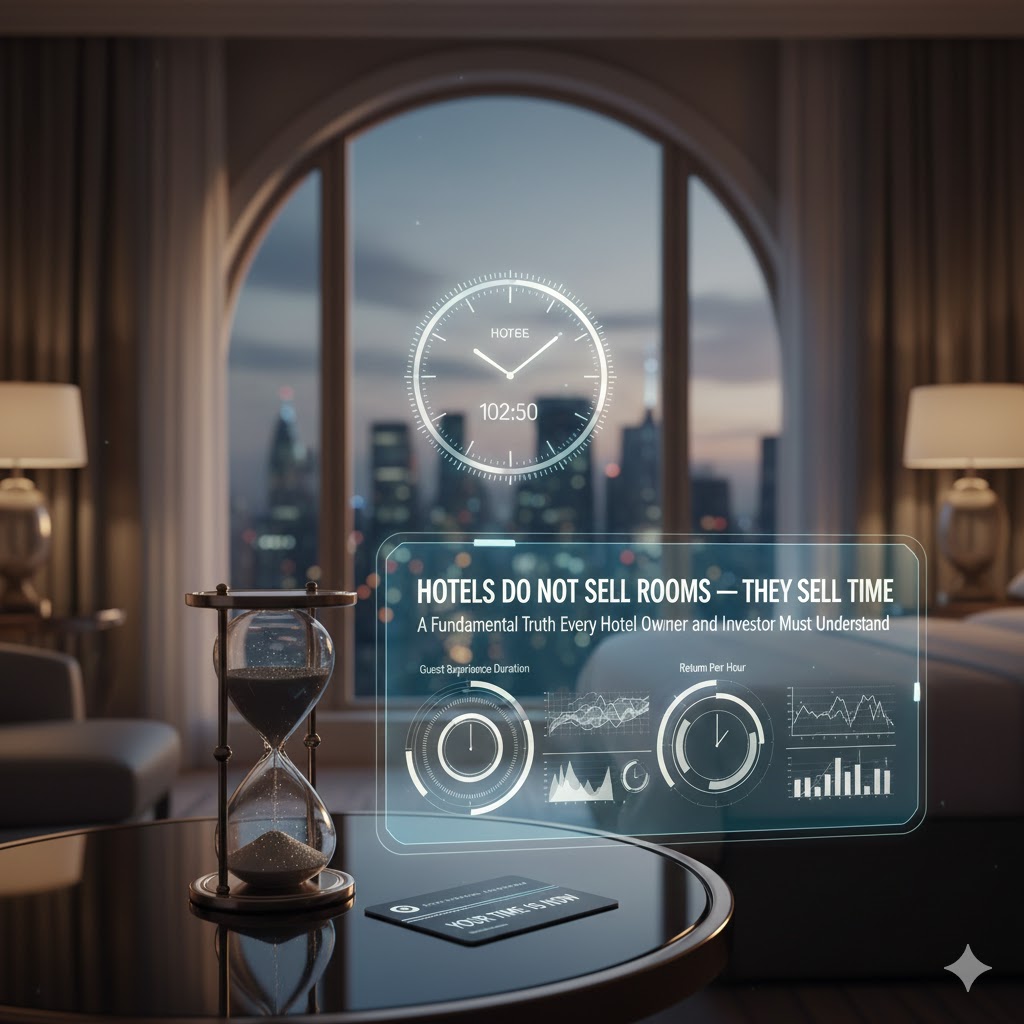
“Hotels do not sell rooms. They sell time.”
This is not a poetic metaphor. It is a commercial truth that sits at the very core of hotel profitability, revenue strategy, and long-term sustainability. Owners and operators who truly understand this principle manage pricing, demand, and profitability very differently from those who do not.
What Is a Hotel Really Selling?
A hotel does not sell:
- A bed
- A room size
- A physical asset
A hotel sells:
✔️ The right to occupy a room for a specific period of time
✔️ A moment of rest, productivity, experience, or recovery
Each room has only 24 hours per day to sell.
If a room remains unsold tonight, that time:
Expires forever.
It cannot be stored, postponed, or recovered.
This makes hotel inventory one of the most perishable assets in business.
Time Is the Most Fragile Asset in Hospitality
Unlike retail or manufacturing:
- Unsold clothing can be sold tomorrow
- Unsold products can be stored
But in hotels:
An empty room equals lost revenue — permanently
This reality fundamentally changes how pricing and sales must be approached. The goal is not merely to achieve high occupancy, but to sell the right time, to the right customer, at the right price, through the right channel.
A Practical Perspective: Thailand Market Examples
Resort Hotels
Weekend nights, long weekends, and high season represent premium time.
A resort that sells peak-season nights at weekday rates is effectively:
- Selling its most valuable time at a discount
- Leaving revenue and profit on the table
Well-managed resorts protect their time value by:
- Yielding prices upward during peak demand
- Applying minimum stay controls
- Reducing unnecessary promotions
City Hotels
In urban markets, time value shifts by day of week:
- Monday–Friday: Corporate and business demand
- Saturday–Sunday: Leisure and domestic travellers
Hotels that price all nights equally are not managing rooms —
they are mispricing time.
Revenue Management Is the Art of Selling Time
True Revenue Management is not about filling rooms.
It is about maximising the value of each available night.
That is why performance is measured through:
- RevPAR – Revenue per Available Room
- TRevPAR – Total Revenue per Available Room
- GOPPAR – Gross Operating Profit per Available Room
These metrics answer one critical question:
How effectively is the hotel monetising its time?
Restaurants Sell Time Too
This principle extends beyond hotels.
Restaurants do not sell tables —
they sell table time.
- An empty table = lost time
- Slow service = inefficient time use
- Guests occupying tables without incremental spend = opportunity loss
The most profitable restaurants manage:
- Table turnover during peak hours
- Experience-led dining during off-peak periods
- Menu engineering aligned with time-based demand
The Leadership Insight
Hotels and restaurants that consistently outperform the market share one mindset:
✔️ They respect time as their most valuable asset
✔️ They price time according to demand, not emotion
✔️ They avoid unnecessary discounting
✔️ They understand that once time is gone, revenue is gone with it
Rooms are assets.
Time is the product.
Pricing is the strategy that transforms time into profit.
About Vigor Hotel Solutions
At Vigor Hotel Solutions, we help owners, investors, and operators rethink hospitality performance through strategic clarity, commercial discipline, and operational precision — always grounded in human experience.
Because in hospitality,
success is not about selling more rooms — it is about selling time wisely.