By Charles Tan
In the dynamic world of hospitality, adept room inventory management is the bedrock of maximizing revenue and occupancy. The terms “Group Block” and “Allotment” are frequently encountered when discussing large-volume room reservations. However, a nuanced understanding reveals distinct differences in their nature, agreements, and operational management.
What is a Group Block?
A Group Block is the strategic reservation of a specific set of rooms for a single party of guests who intend to stay concurrently. This could encompass anything from corporate conferences, incentive travel groups, and large-scale conventions to elegant weddings or sports teams. Group Blocks are characterized by highly specific terms and conditions:
- Fixed Dates and Duration: A precise timeframe for the group’s stay.
- Specific Room Types: Often dictates particular room categories (e.g., standard doubles, executive suites).
- Negotiated Rates: Groups typically benefit from specially discounted rates agreed upon in advance.
- Binding Contract: A formal, signed agreement between the hotel and the group organizer, detailing room numbers, rates, payment terms, and cancellation policies.
- Cut-off Date: A critical deadline by which the group organizer must finalize their room count. Any rooms not confirmed by this date are typically released back into the hotel’s general inventory for open market sales.
Illustrative Group Block Scenario:
Imagine “Tech Innovators Inc.” planning their annual summit, requiring 50 rooms for three nights. The hotel would establish a Group Block agreement, holding these 50 rooms exclusively for Tech Innovators during the specified period, at a special rate, and with a defined cut-off date for final confirmation.
Distinguishing Group Block from Allotment
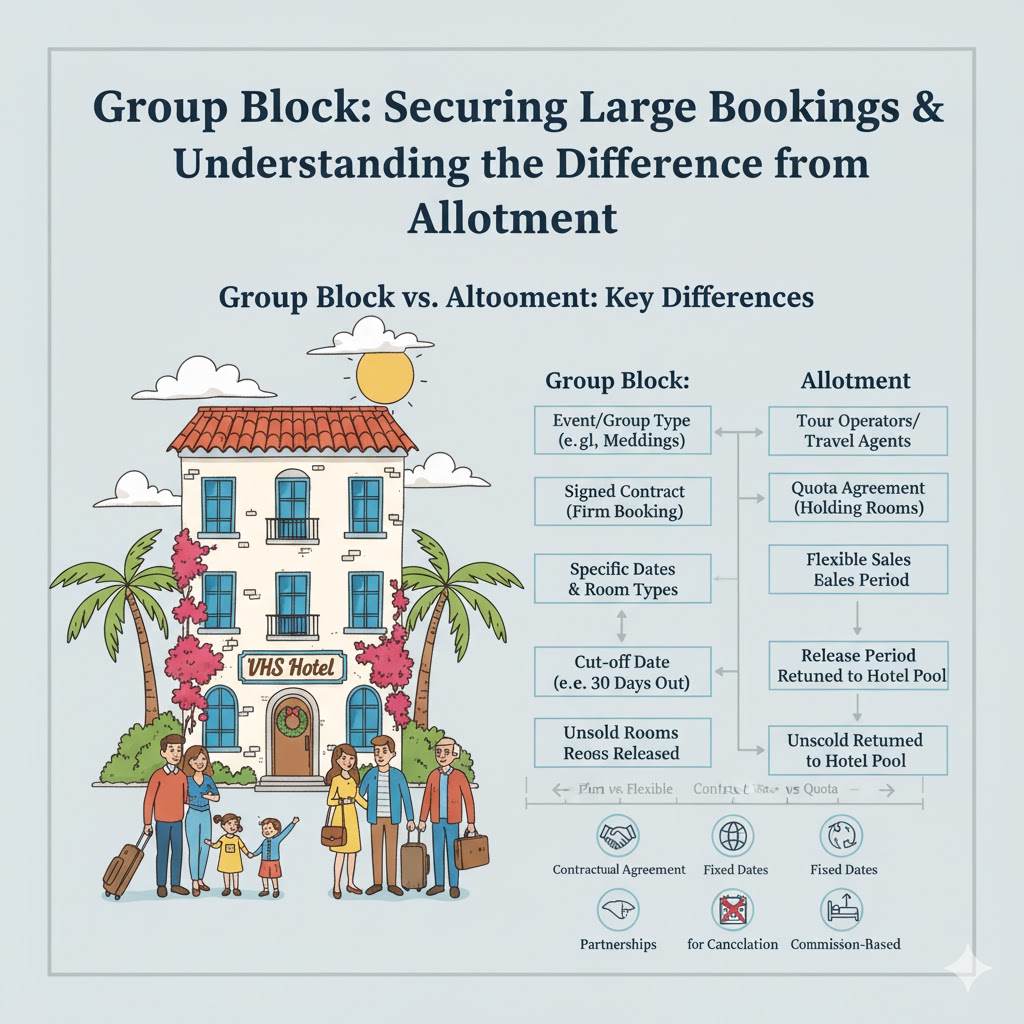
While both mechanisms involve holding multiple rooms, their fundamental purposes and operational mechanics diverge significantly:
|
Feature |
Group Block |
Allotment |
|
Primary Purpose |
To accommodate a cohesive group for a specific event |
To empower tour operators/agents with immediate selling capability |
|
Nature of Hold |
A “Firm” or “Confirmed” reservation |
A “Soft Hold” or quota of rooms by a third-party distributor |
|
Agreement Type |
A binding, often detailed, legal contract |
A quota agreement, potentially more flexible/less formal |
|
Flexibility |
Less flexible; requires confirmation by Cut-off Date |
More flexible; features a Release Period for unsold rooms |
|
Room Control |
Hotel retains control until the Cut-off Date |
Third-party “holds” the inventory, with immediate selling rights |
|
Payment Terms |
Often involves advance deposits |
Can be pre-paid (bulk purchase) or commission-based |
|
Hotel Risk |
Penalties for cancellations/reductions after Cut-off Date |
Unsold rooms revert to hotel inventory after Release Period |
Key Differentiator Summary:
A Group Block is a relatively firm, contractual booking for a specific client group tied to a particular event, with a hard cut-off date for confirmation.
An Allotment is a more fluid quota of rooms granted to a third-party distributor, empowering them to sell directly and quickly, with a flexible release period allowing the hotel to reclaim unsold inventory.
Why Does This Distinction Matter?
A precise understanding of the difference between Group Blocks and Allotments empowers hotels to:
- Optimize Revenue Management: Make informed decisions on how to allocate inventory, ensuring maximum profitability and minimized risk.
- Strategic Resource Planning: Accurately forecast guest numbers, enabling efficient allocation of staff, F&B, and other operational resources.
- Effective Contract Negotiation: Craft agreements that are equitable, mutually beneficial, and protect the hotel’s interests.
The judicious deployment of either Group Blocks or Allotments depends on the customer segment, market demand, and the hotel’s overall business strategy. Leveraging both tools intelligently is key to enhancing competitiveness and fostering sustainable success in the hospitality industry.