How Customer Persona and the Business Model Canvas Drive Relevance, Differentiation, and Long-Term Performance
By Charles Tan
In today’s restaurant landscape, differentiation is no longer a matter of creativity alone.
Good food, appealing design, and competitive pricing have become baseline expectations rather than competitive advantages.
Sustainable performance now depends on a restaurant’s ability to create value that is clearly defined, operationally deliverable, and economically resilient.
This requires more than concepts—it requires alignment.
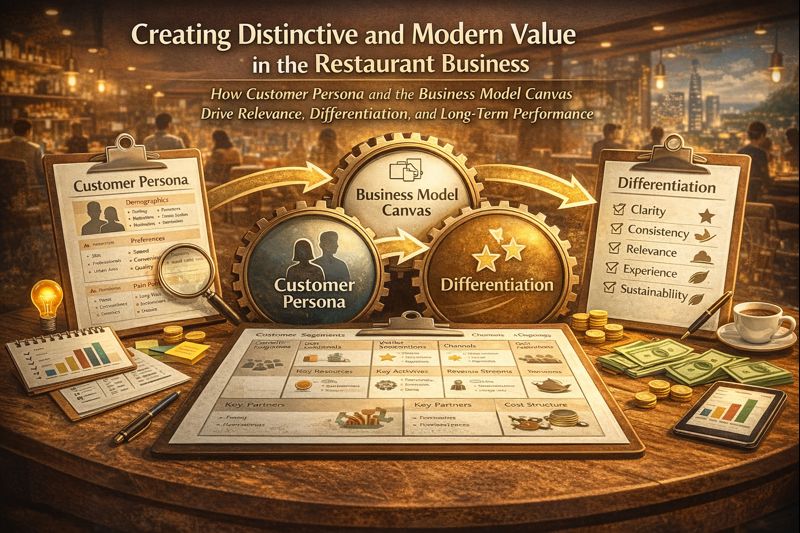
At a strategic level, high-performing restaurant businesses integrate three elements into a single operating logic:
- Customer Persona – who the business is intentionally built for
- Value Differentiation – why that guest chooses the restaurant
- Business Model Canvas – how the organization consistently delivers and sustains that value
When these elements are aligned, differentiation becomes measurable performance rather than marketing language.
Customer Persona: The Foundation of Modern Relevance
Customer Persona defines the economic reality of the restaurant.
It clarifies not only who the guest is, but why the guest comes, what problem the visit solves, and what trade-offs the guest is willing to accept.
Without a clearly articulated persona, restaurants tend to:
- Overextend menus and concepts
- Chase multiple guest segments simultaneously
- Complicate operations while diluting value
With a defined persona, decision-making becomes disciplined.
Menu design, service style, pricing, space planning, and marketing channels gain coherence.
In practice, Customer Persona is the interpretive lens through which every component of the Business Model Canvas should be designed.
Differentiation: Translating Persona into Tangible Value
Differentiation is not created for the market at large.
It is created for a specific guest, in a specific context, at a specific moment.
Modern restaurant value is defined by relevance rather than novelty:
- Time-constrained professionals value predictability and efficiency
- Families value comfort, clarity, and emotional ease
- Lifestyle-driven guests value identity, narrative, and experience
Each persona implies a different value equation—and therefore a different business model.
Effective differentiation simplifies the guest’s decision while reducing operational friction.
It makes the restaurant easier to choose, easier to operate, and easier to sustain.
Embedding Differentiation into the Business Model Canvas
Customer Segments
Persona clarity prevents structural conflict.
Restaurants attempting to serve incompatible segments often suffer from complexity and margin erosion.
Value Proposition
A modern value proposition is not aspirational—it is executable.
It must be consistently deliverable within the realities of people, processes, and cost structure.
Channels and Customer Relationships
Channels and relationship design must reflect how the persona actually interacts with the brand.
Misalignment here creates friction, not differentiation.
Revenue Streams
When value is clearly defined, pricing becomes credible.
Restaurants reduce reliance on discounts and stabilize revenue performance over time.
Key Resources and Activities
Sustainable differentiation relies on systems, standards, and repeatable processes—not individual heroics.
Operational discipline is where strategic intent becomes guest experience.
Partnerships and Cost Structure
Aligned partners and intentional cost structures reinforce differentiation.
Poor alignment silently erodes value, even when surface-level metrics appear favorable.
From Differentiation to Performance: The System Effect
When Customer Persona, Differentiation, and the Business Model Canvas are aligned:
- Strategic decisions become faster and less subjective
- Operations become simpler rather than more complex
- Marketing becomes more precise and cost-effective
- Teams understand not just what they do, but why they do it
Most importantly, the business becomes resilient—able to adapt without losing identity.
Long-Term Performance as a Design Outcome
From an investor and operator perspective, sustainable restaurant performance is rarely accidental.
It is the result of intentional design.
Restaurants that endure are not those with the boldest ideas,
but those where:
- The right guest is clearly defined
- The value proposition is unmistakable
- The business model is structured to support it—every day, at scale
Customer Persona provides focus.
The Business Model Canvas provides structure.
Distinctive, modern value is the outcome.
Closing Perspective
In an increasingly competitive global market, restaurants do not win by being louder or more complex.
They win by being clear, relevant, and system-driven.
Creating distinctive and modern value is not a branding exercise.
It is a strategic discipline—one that connects differentiation directly to long-term performance.