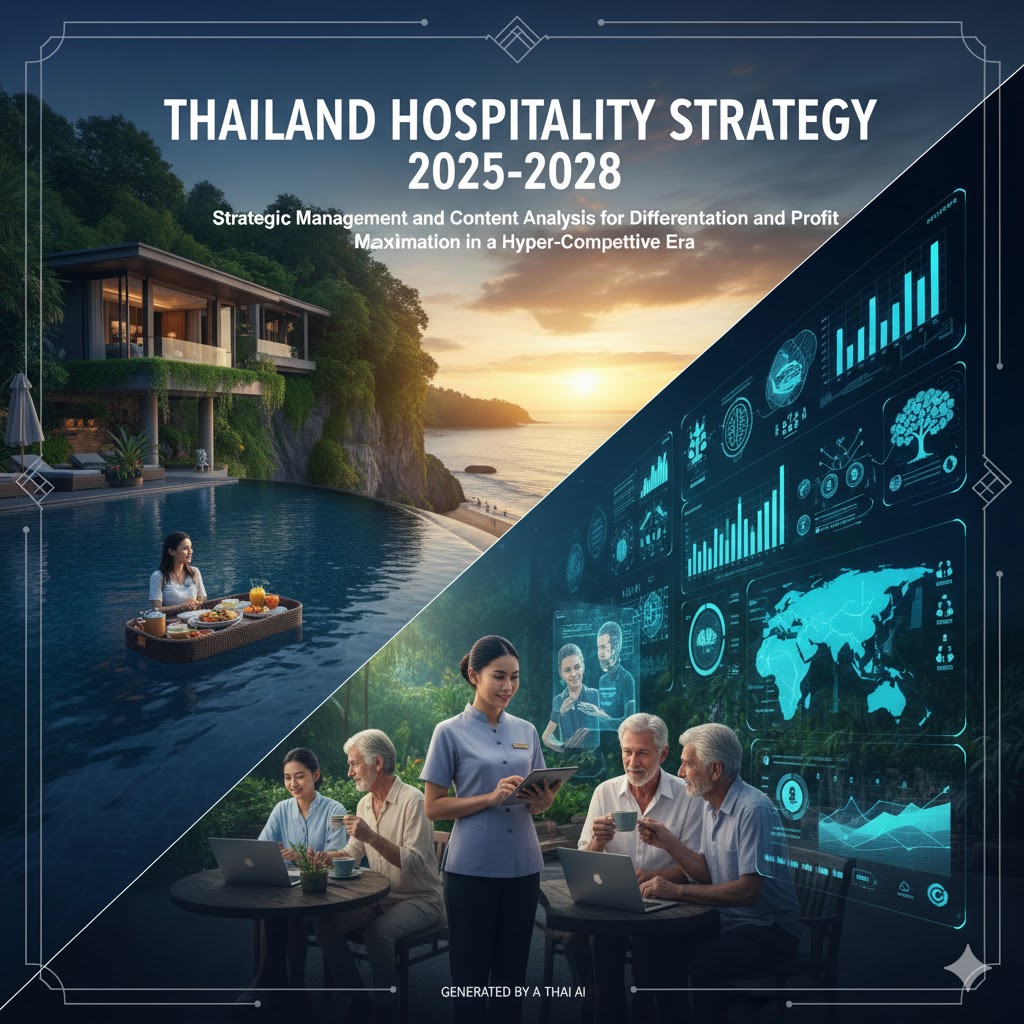
Strategic Management and Content Analysis for Differentiation and Profit Maximization in a Hyper-Competitive Era
By Charles Tan
Executive Summary
Thailand’s hotel and accommodation sector stands at a critical inflection point in 2025. While overall industry revenues are projected to contract by 4.5%, a stark divergence is emerging: premium 4-5 star properties focusing on quality and experiential excellence are thriving, while mid-tier establishments face mounting pressures. This comprehensive strategic analysis presents a roadmap for hospitality operators to navigate structural challenges, capitalize on emerging opportunities, and achieve sustainable profitability through differentiation, operational excellence, and authentic value creation.
The recovery is unmistakably K-shaped. European travelers, now staying an average of 16+ days—double the duration of pre-pandemic Chinese tourists—are driving demand for premium experiences. This shift presents both opportunity and imperative: operators must elevate service standards, embrace niche markets, and transform cost structures to align with higher Average Daily Rates (ADR) while delivering commensurate value.
This document analyzes three critical dimensions: market dynamics and competitive pressures, proven differentiation strategies through content marketing and niche positioning, and three groundbreaking untapped opportunities—Silver Economy luxury assisted living, AI-augmented human-centric workplaces, and hyper-local ethno-tourism partnerships. Together, these strategies form a comprehensive framework for sustainable competitive advantage in Thailand’s evolving hospitality landscape.
- Market Landscape and Context for 2025
1.1 Market Volatility and Polarization
Thailand’s hospitality sector is experiencing an uneven recovery that threatens to create permanent stratification within the industry. While aggregate revenues may contract by 4.5% in 2025, this headline figure masks a profound divergence: coastal properties are experiencing robust, sustained growth since late 2024, while properties in other zones face concerning quietude.
The K-Shaped Recovery: Winners and Losers
This bifurcation reflects fundamental shifts in traveler behavior and preferences. Post-pandemic tourism patterns reveal a decisive tilt toward 4-5 star accommodations, with travelers increasingly willing to pay premium rates for enhanced experiences, safety, and service quality. This trend is particularly pronounced among European visitors, whose extended Length of Stay (LOS) averaging 16+ days—double that of Chinese tourists who dominated pre-2019—creates exceptional opportunities for revenue optimization.
The implications are stark: properties positioned to serve this discerning, higher-spending, longer-staying demographic can command elevated ADR and achieve superior Revenue Per Available Room (RevPAR). Conversely, mid-tier properties (3-star and below) lacking clear differentiation face an existential challenge. They remain trapped between rising operational costs and an inability to raise rates in an increasingly commoditized market segment.
Critical Success Factors:
- Quality Elevation: Upgrading service standards and physical plant to justify premium pricing
- Experience Architecture: Designing memorable, personalized guest journeys that transcend mere accommodation
- Value Perception Management: Ensuring guests perceive clear value proposition relative to elevated rates
The market is essentially bifurcating into “experience-led premium” and “price-driven commodity” segments, with vanishing middle ground. Operators must consciously choose which game they’re playing—and configure their entire operating model accordingly.
1.2 Cost Pressures and Competitive Threats
Despite revenue growth opportunities in premium segments, profitability remains under severe pressure from structural cost increases and intensifying competition. This creates a dangerous squeeze: revenues may be rising, but margins are contracting for operators unable to optimize their cost structure.
Primary Cost Pressures:
- Energy Costs: Electricity rates remain elevated compared to pre-pandemic levels, with limited prospects for near-term relief. For hotel operations—where climate control, lighting, laundry, and kitchen operations drive substantial energy consumption—this represents a permanent structural cost increase.
- Financial Costs: Interest rates and debt service costs remain elevated, particularly challenging for leveraged operators who expanded during the pre-pandemic boom. This financial burden directly impacts net profitability even when operational performance improves.
- Labor Costs: While covered in depth in Section III, the acute skills shortage is forcing wage increases, increased reliance on foreign workers, and conversion from flexible to permanent staffing—all driving operational expenses upward.
The Competitive Threat Matrix:
Beyond cost pressures, operators face intensifying competition from multiple vectors:
Home Sharing Platforms: Airbnb and similar platforms continue expanding, particularly in urban and tourist hotspots. While regulatory frameworks are evolving, these platforms offer travelers perceived authenticity and value that traditional hotels must counter with superior service and experience.
Regulatory Uncertainty: Potential changes to foreign ownership regulations for condominiums could unleash a wave of short-term rental supply, potentially triggering destructive price competition. This looming threat makes differentiation and brand loyalty even more critical.
Price War Vulnerability: Properties lacking clear differentiation are forced to compete primarily on price, a race to the bottom that erodes profitability for all players. This commoditization trap is particularly acute for properties unable to articulate and deliver distinctive value propositions.
Strategic Response: The Turnaround Template
Leading operators demonstrate that survival and profitability require simultaneous action on multiple fronts:
- Revenue Optimization: Moving beyond simple occupancy maximization to sophisticated revenue management that optimizes ADR, channel mix, and ancillary revenue
- Cost Discipline: Implementing rigorous cost management without compromising guest experience
- Financial Restructuring: Aggressively reducing financial costs through refinancing and deleveraging
Case Example: Singha Estate achieved 23% interest expense reduction in the first nine months of 2025, directly contributing to returning to net profitability. This demonstrates that financial engineering, while less glamorous than revenue growth initiatives, is equally critical to unlocking enterprise value.
Table 1: Core Challenges and Response Strategies in Thai Hospitality (2025)
|
Core Challenge |
Impact on Operations |
Current Strategies |
Success Metrics |
|
Acute Skills Shortage |
• Increased OPEX |
• Foreign worker recruitment |
• Turnover rate |
|
Elevated Energy/Financial Costs |
• Margin compression |
• Building Energy Management Systems (BEMS) |
• Energy cost per occupied room |
|
Intensified Competition |
• Price war pressure |
• Premium positioning (4-5 star focus) |
• ADR trends |
- High-Impact Management and Content Strategies
Current management strategies gaining traction focus on differentiation through content marketing and niche market penetration as primary tools for RevPAR optimization. These approaches recognize a fundamental truth: in a hyper-competitive environment where physical amenities can be replicated, sustainable competitive advantage derives from brand strength, customer relationships, and experience delivery excellence.
2.1 Differentiation and Brand Building Strategies
In highly competitive markets, differentiation transcends luxury—it becomes existential. Properties that fail to establish clear, defensible differentiation inevitably slide into commodity competition, where pricing power evaporates and profitability suffers. The core challenge: how to create and communicate distinctive value that resonates with target segments and justifies premium positioning.
The Foundation: Brand Identity and Narrative
Effective differentiation begins with crystallizing brand identity—who you are, what you stand for, and why guests should choose you over alternatives. This requires:
- Deep Market Segmentation: Moving beyond demographic basics (age, income) to psychographic and behavioral insights. What motivates your ideal guest? What problems are they trying to solve? What experiences do they value most?
- Authentic Positioning: Developing a brand position that is simultaneously distinctive, credible, and sustainable. The position must reflect genuine organizational capabilities and values—not aspirational fiction.
- Compelling Narrative: Crafting a brand story that emotionally engages target guests and creates memorable differentiation. The most powerful hotel brands tell stories that guests want to be part of—stories of place, heritage, values, or lifestyle.
Experience Architecture: Beyond Service to Memory Creation
Physical amenities and standard services are increasingly commoditized. True differentiation derives from experiential excellence—creating moments and memories that guests treasure and share. This requires:
- Personalization at Scale: Leveraging guest data and modern technology to deliver individually tailored experiences without losing operational efficiency
- Surprise and Delight Moments: Deliberately engineering unexpected positive experiences that exceed expectations
- Emotional Intelligence: Training staff to read, respond to, and anticipate guest emotional states and needs
- Authentic Local Connection: Creating opportunities for guests to connect with place, culture, and community in meaningful ways
Content Strategy: The Differentiation Multiplier
In the digital age, content is not mere marketing—it’s the primary vehicle through which brands establish expertise, build relationships, and influence booking decisions. Effective content strategy:
- Establishes Thought Leadership: Positioning the property as expert guide to the destination, not just a place to sleep
- Enables Discovery: Creating content that intercepts guests early in their journey, building awareness and preference before active booking
- Drives Direct Booking: Reducing dependence on OTAs (Online Travel Agencies) by building direct relationships with guests, protecting ADR by avoiding commission costs
- Enhances SEO Performance: Strategically incorporating relevant keywords related to local attractions, cultural activities, and authentic Thai experiences to improve search rankings and organic traffic
Content Pillars for Thailand Properties:
- Destination Expertise: In-depth guides to local attractions, hidden gems, and seasonal highlights
- Cultural Immersion: Stories and information about Thai culture, traditions, and authentic experiences
- Wellness and Transformation: Content positioning the property as facilitator of personal transformation through wellness, adventure, or cultural immersion
- Sustainability and Impact: Demonstrating authentic commitment to environmental and community stewardship
The properties that master content strategy don’t just fill rooms—they build communities of advocates who return repeatedly and recommend enthusiastically.
2.2 Niche Market Penetration for ADR and LOS Optimization
Mass market approaches are increasingly ineffective in fragmented, hyper-competitive hospitality markets. Niche marketing offers a superior alternative: by serving specific, well-defined segments exceptionally well, properties can command premium pricing, reduce direct competition, and build defensible market positions.
The Niche Advantage:
- Reduced Competition: Fewer properties compete for specialized segments
- Premium Pricing Power: Guests with specific needs willingly pay more for tailored solutions
- Marketing Efficiency: Targeted marketing to defined segments costs less and converts better than broadcast approaches
- Guest Loyalty: Satisfaction with specialized offerings drives higher retention and advocacy
- Wellness Seekers & Medical Tourism
The wellness tourism market represents one of the most compelling opportunities in global hospitality, with the Global Wellness Institute projecting approximately 21% annual growth through 2025. Thailand possesses extraordinary competitive advantages in this space: world-class medical infrastructure, highly trained professionals, and costs 40-60% below those in Singapore, Japan, or Western markets.
Market Segment Characteristics:
Wellness seekers span a continuum from “wellness-curious” travelers adding spa experiences to beach vacations, to serious medical tourists undergoing elective procedures or comprehensive health optimization. The most attractive segments:
- Holistic Wellness Retreats: Guests seeking week-long immersive programs combining spa treatments, yoga, meditation, nutritional guidance, and personal transformation
- Medical Wellness: Travelers combining medical procedures (cosmetic surgery, dental work, health screenings) with recovery and vacation
- Longevity Optimization: Affluent guests seeking anti-aging treatments, regenerative medicine, and health optimization protocols
Strategic Positioning Requirements:
Success in wellness tourism demands more than adding a spa. It requires:
- Clinical Credibility: Partnerships with certified medical professionals and accredited healthcare facilities
- Program Design Excellence: Curated wellness programs designed by qualified practitioners, not marketing departments
- Facility Standards: Treatment rooms, fitness facilities, and therapeutic environments meeting exacting standards
- Outcome Orientation: Focus on measurable results (weight loss, fitness improvement, biomarker optimization) not just pampering
Content Strategy for Wellness:
Content must establish expertise and inspire confidence:
- Medical Authority: Featuring qualified healthcare professionals, certifications, and safety protocols
- Transformation Stories: Authentic testimonials and case studies (with appropriate privacy protections)
- Educational Content: Explaining treatment modalities, benefits, and what guests can expect
- Holistic Lifestyle: Connecting wellness to broader lifestyle aspirations beyond individual treatments
Revenue Impact:
Wellness positioning enables significant ADR premiums (20-50% above standard rates) plus substantial ancillary revenue from treatments, supplements, and wellness retail. A guest on a week-long wellness program might generate 3-4x the revenue of a standard leisure guest through bundled program fees and additional services.
- Digital Nomads: The New Business Traveler
The remote work revolution has created a massive, rapidly growing segment: professionals who work remotely while traveling—digital nomads (DN). Thailand ranks consistently among the world’s top destinations for this demographic, driven by affordable cost of living, excellent quality of life, robust infrastructure, and vibrant DN communities in Bangkok, Chiang Mai, and Phuket.
Market Segment Characteristics:
Digital nomads are not traditional tourists. They’re typically:
- Duration-Focused: Staying weeks to months, not days
- Value-Conscious: Evaluating total cost of living, not just nightly rates
- Infrastructure-Dependent: Requiring fast, reliable internet, comfortable workspaces, and community
- Experience-Seeking: Valuing cultural immersion and social connection alongside work productivity
Strategic Positioning Requirements:
Capturing DN guests requires rethinking the traditional hotel model:
- Infrastructure Excellence:
- Ultra-reliable, high-speed internet (minimum 50-100 Mbps, ideally 200+ Mbps)
- Dedicated co-working spaces with ergonomic furniture, multiple seating options, and quiet zones
- Backup power and internet redundancy
- Meeting rooms for video calls
- Community Building:
- Regular networking events and social gatherings
- Slack channels or WhatsApp groups for guest connection
- Partnerships with local DN communities and co-working spaces
- Skill-sharing workshops and social activities
- Flexible Pricing Models:
- Weekly and monthly rates offering significant discounts from daily rates
- All-inclusive packages bundling accommodation, workspace access, and utilities
- Tiered packages (basic room vs. suite) allowing DNs to choose appropriate tier
Content Strategy for Digital Nomads:
Content should address practical concerns and aspirations:
- Infrastructure Transparency: Detailed information about internet speeds, workspace options, and connectivity
- Community Showcasing: Profiles of DN guests, photos of community events, testimonials about the social environment
- Practical Guides: Information about visas, cost of living, transportation, healthcare, and banking
- Productivity Enablement: Content about maintaining work-life balance, productivity tips for the location, and success stories
Revenue Impact:
While DNs typically pay lower nightly rates, their extended stays create:
- High Occupancy: Filling rooms during traditional shoulder and low seasons
- Stable Revenue: Predictable income from monthly stays reduces volatility
- Reduced Turnover Costs: Fewer check-ins/check-outs reduce housekeeping and administrative expenses
- Ancillary Opportunities: F&B sales, laundry services, and workspace upgrades generate additional revenue
A 30-night DN stay at 30% below standard rates still generates far more total revenue and profit than sporadic 2-3 night leisure stays.
Table 2: Niche Market Comparison: Wellness vs. Digital Nomads
|
Dimension |
Wellness Seekers |
Digital Nomads |
Financial Outcome |
|
Stay Characteristics |
Deep immersion in treatment/transformation |
Flexibility and autonomy |
High ADR + High Ancillary Revenue vs. Moderate ADR + High Occupancy |
|
Length of Stay (LOS) |
Short to medium: 3-7 days |
Medium to long: 7 days to 3+ months |
Wellness: High ADR × Moderate LOS |
|
Infrastructure Needs |
Treatment facilities |
Ultra-fast, reliable internet |
Wellness: Capital-intensive facility investment |
|
Content Marketing Focus |
Nutrition and diet programs |
Co-working spaces |
Both: SEO-optimized content drives direct booking and reduces OTA dependency |
|
Primary Revenue Drivers |
Premium room rates |
Extended stay occupancy |
Wellness: Revenue per guest |
“Continued on page II