By Charles Tan
In an era where hospitality has undergone a seismic shift toward digital commerce, managing distribution channels has evolved from a tactical necessity into a strategic imperative. The Channel Manager—once viewed as a luxury reserved for large hotel chains—has become an indispensable tool for properties of all sizes competing in an increasingly complex marketplace. Understanding its nuances isn’t merely advantageous; it’s essential for survival and growth in contemporary hospitality.
Defining the Concept: Beyond Simple Software
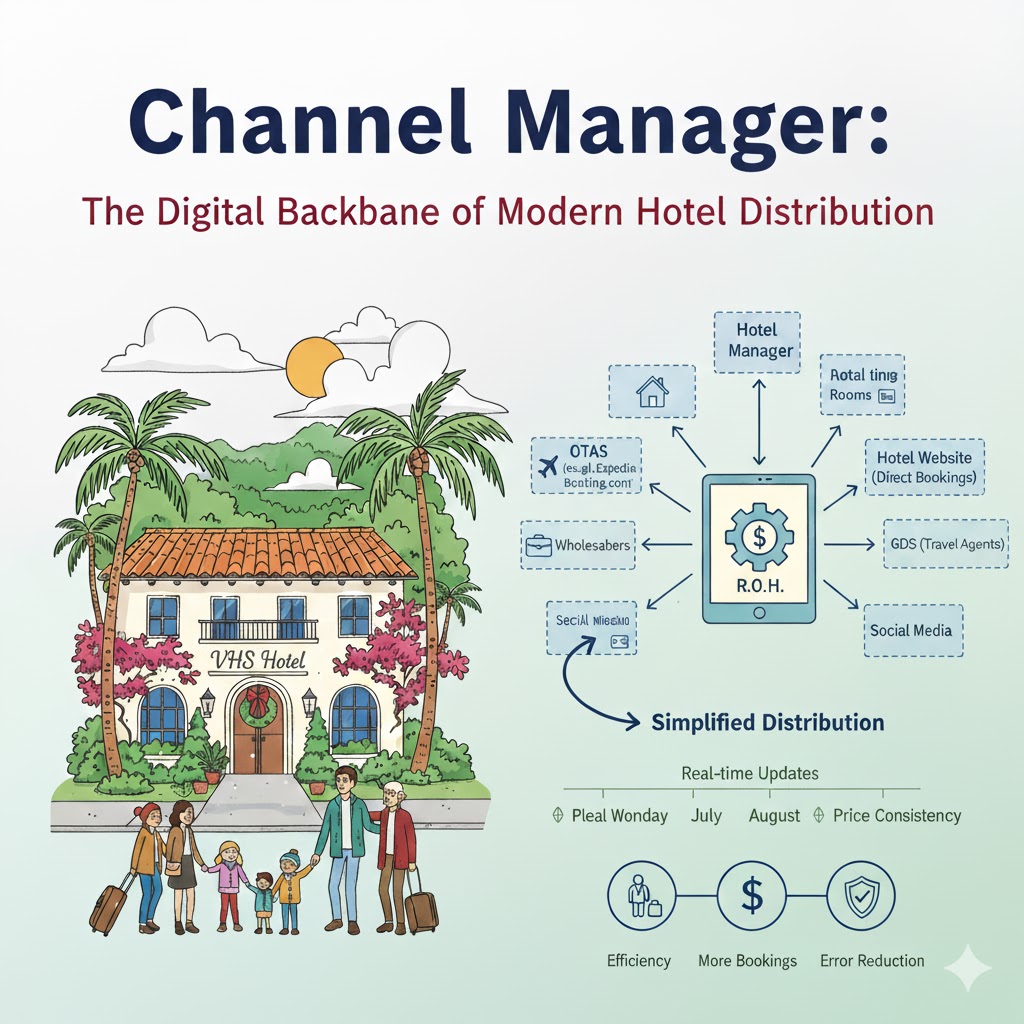
A Channel Manager is a cloud-based software platform that serves as the central nervous system for a hotel’s online distribution strategy. It synchronizes real-time data—inventory, rates, availability, and restrictions—between a property’s Property Management System (PMS) and the sprawling ecosystem of online booking platforms that define modern travel commerce.
The fundamental principle underlying Channel Management is elegant in its simplicity: establish a single source of truth for property data, then propagate that information consistently and instantaneously across every sales channel. This architectural approach transforms what was once a labyrinth of manual updates into a streamlined, automated process that responds in real-time to market dynamics.
The Evolution of Hotel Distribution: A Brief History
The Pre-Internet Era (1980s-1990s)
Hotels relied primarily on telephone reservations, walk-ins, and Global Distribution Systems (GDS) serving travel agents. Distribution management remained relatively straightforward, constrained by limited channels and manageable through manual oversight.
The OTA Dawn (Early 2000s)
As Booking.com, Expedia, and Agoda gained traction, hoteliers faced a new challenge: managing multiple digital channels simultaneously through separate extranet interfaces. This fragmented approach introduced the first waves of overbooking nightmares and operational complexity that tested even the most organized revenue management teams.
The Channel Manager Revolution (2010s-Present)
With the proliferation of booking channels—including metasearch engines, social commerce, direct booking platforms, and alternative accommodations marketplaces—manual management became untenable. Channel Managers transitioned from optional efficiency tools to fundamental operational infrastructure.
Architectural Framework: How Channel Managers Function
Core Components
1. Integration Hub
The cornerstone of any Channel Manager connects bidirectionally with the hotel’s PMS, extracting inventory, rate, and availability data in real-time. Modern integrations utilize robust APIs that facilitate seamless data flow, eliminating the latency and errors inherent in manual processes.
2. Distribution Network
Through XML connections and proprietary APIs, the Channel Manager interfaces with OTAs, GDS platforms, metasearch engines, and direct booking channels. Leading systems maintain connections with 400+ distribution partners globally, providing unprecedented market reach.
3. Control Dashboard
An intuitive interface empowers revenue managers to execute rate changes, impose booking restrictions, and open or close channels from a unified command center. The best systems balance powerful functionality with user-friendly design.
4. Analytics & Reporting Module
Aggregating booking data across all channels, this component transforms raw transaction information into actionable intelligence, revealing performance patterns and opportunities invisible in channel-siloed data.
Operational Workflow
Consider a typical booking scenario on Booking.com:
- Booking Receipt – The OTA transmits reservation details to the Channel Manager
- Inventory Adjustment – The system automatically decrements available inventory
- Distribution Propagation – Updated availability cascades to all connected channels within 1-3 seconds
- PMS Synchronization – Booking details flow seamlessly into the hotel’s core management system
- Confirmation Loop – The system verifies successful synchronization across all touchpoints
This entire sequence executes autonomously, without human intervention, eliminating the delays and errors that plague manual processes.
Strategic Advantages: Beyond Operational Convenience
1. Revenue Optimization Through Agility
Dynamic Pricing Mastery
The velocity of modern markets demands pricing agility that manual processes simply cannot achieve. Channel Managers enable revenue managers to implement sophisticated dynamic pricing strategies, adjusting rates in response to demand fluctuations, competitive positioning, and market conditions across all channels simultaneously.
Channel Mix Optimization
With comprehensive visibility into channel performance—including conversion rates, cancellation patterns, and net revenue contribution—hoteliers can make data-driven decisions about inventory allocation. Which channels deserve preferential treatment? Where should inventory be restricted? These questions, once answered through intuition, now yield to analytical rigor.
Strategic Length of Stay Management
Sophisticated Channel Managers allow differentiated minimum and maximum stay requirements across channels, enabling strategies like requiring three-night minimums on high-commission OTAs during peak periods while maintaining flexible booking windows on direct channels to incentivize disintermediation.
2. Operational Efficiency: Quantifying Time Savings
Consider a 50-room property connected to ten OTAs without a Channel Manager:
- Daily availability updates: 30 minutes × 2 = 60 minutes
- Rate adjustments: 45 minutes daily
- Restriction management: 20 minutes daily
- Total: 125 minutes daily, or 760+ hours annually
With a Channel Manager, these tasks compress to 15-20 minutes daily—a time savings exceeding 700 hours annually. That’s nearly a full-time employee’s worth of productivity redirected toward higher-value activities: refining guest experiences, developing promotional strategies, or conducting market analysis.
Resource Reallocation Dividends
The productivity gains extend beyond mere time savings. When revenue management teams escape the drudgery of manual updates, they can focus on strategic thinking, market analysis, and the creative problem-solving that drives competitive advantage.
3. Risk Mitigation: The Hidden Value Proposition
Overbooking Prevention
The true cost of overbooking extends far beyond the immediate expense of walking guests to alternative properties. Consider the cascading damage:
- Irrevocable reputation harm on review platforms
- Lost lifetime value of alienated guests
- Staff time consumed in crisis management
- Diminished employee morale from confronting angry guests
- Potential OTA penalties and reduced visibility
Channel Managers virtually eliminate this risk through instantaneous synchronization, protecting both revenue and reputation.
Rate Parity Compliance
OTAs increasingly enforce rate parity through both contractual obligations and algorithmic search ranking penalties. Violations—even unintentional ones stemming from manual update lag—can result in dramatic visibility reduction. Channel Managers ensure consistent pricing across all channels, maintaining compliance while preserving OTA relationships.
4. Market Intelligence: Data as Competitive Advantage
Booking Pattern Analytics
Understanding which channels generate bookings with what lead times, cancellation rates, and average length of stay transforms distribution from guesswork into science. These insights inform marketing investments, inventory allocation strategies, and promotional timing.
Channel Performance Benchmarking
Evaluating channel effectiveness requires looking beyond gross bookings to net revenue contribution. A channel generating high volume but demanding excessive commission, delivering guests with high cancellation rates, or attracting problematic guests may perform poorly despite impressive booking counts. Comprehensive analytics illuminate these nuances.
Seasonal Trend Identification
Multi-year data reveals recurring patterns that enable proactive planning. When historical data demonstrates that a specific week consistently sees last-minute bookings from a particular channel, savvy revenue managers can structure their rate and inventory strategy accordingly.
Selecting the Optimal Channel Manager
Critical Evaluation Criteria
1. Integration Capabilities
- Seamless PMS compatibility through robust API connections
- Comprehensive OTA coverage including regional and specialty platforms
- GDS connectivity for corporate and travel agent bookings
- Metasearch integration for visibility on comparison platforms
2. User Experience & Accessibility
- Intuitive interface requiring minimal training
- Mobile accessibility for management on-the-go
- Customizable dashboards reflecting individual workflow preferences
- Multi-user capabilities with appropriate permission hierarchies
3. Reliability & Performance
- Uptime guarantees exceeding 99.5%
- Synchronization speed under three seconds
- Redundant architecture ensuring business continuity
- Proven track record with verifiable references
4. Support Infrastructure
- 24/7 customer support across multiple channels
- Dedicated account management for complex properties
- Rapid response times with escalation protocols
- Comprehensive documentation and training resources
5. Scalability & Flexibility
- Accommodation of property growth without platform migration
- Easy addition of new channels as distribution strategy evolves
- Pricing structures that scale fairly with property size
- API access for custom integrations and reporting
6. Analytics & Reporting
- Comprehensive, actionable reporting across key metrics
- Data export capabilities for advanced analysis
- Customizable dashboards reflecting unique KPIs
- Predictive analytics and revenue forecasting tools
Property-Specific Recommendations
Boutique & Small Properties (10-30 rooms)
- RoomRaccoon: All-in-one platform with integrated PMS
- Cloudbeds: User-friendly interface ideal for smaller teams
- eZee Centrix: Cost-effective solution with solid fundamentals
Mid-Sized Hotels (31-100 rooms)
- SiteMinder: Industry-leading connectivity and reliability
- STAAH: Strong presence in Asian markets with local support
- MyAllocator: Exceptional flexibility and customization options
Large Hotels & Multi-Property Operations (100+ rooms)
- D-EDGE: Enterprise-grade solution with sophisticated features
- RateGain: Advanced analytics and market intelligence
- TravelClick: Deep integration with major hospitality technology stacks
Implementation Roadmap: From Decision to Optimization
Phase 1: Foundation & Assessment (Weeks 1-2)
Operational Audit
- Comprehensive inventory analysis across room categories
- Current distribution channel mapping with performance data
- PMS capabilities and integration readiness assessment
- Team skill evaluation and training needs identification
Requirements Definition
- Essential channel connections prioritization
- Must-have versus aspirational feature delineation
- Budget parameters and ROI expectations
- Implementation timeline constraints and dependencies
Phase 2: Selection & Configuration (Weeks 3-4)
Vendor Evaluation
- Live demonstrations from 3-4 leading contenders
- Feature-by-feature comparison across priority criteria
- Reference checking with similar properties
- Contract negotiation focusing on pricing and service levels
Technical Setup
- PMS integration configuration and testing
- Channel connection establishment with authentication
- Rate plan architecture and mapping
- Room type configuration with detailed descriptions
- Booking policy and restriction framework establishment
Phase 3: Validation & Testing (Weeks 5-6)
Controlled Launch
- Initial activation of 2-3 primary channels
- End-to-end booking flow validation
- Synchronization accuracy verification
- Issue identification and resolution protocols
Comprehensive Testing
- Rate accuracy verification across all channels
- Real-time availability update confirmation
- Cancellation and modification scenario testing
- Edge case exploration to identify potential issues
Phase 4: Full Deployment (Weeks 7-8)
Phased Rollout
- Gradual channel activation with performance monitoring
- Continuous team feedback collection and response
- Documentation of lessons learned for future optimization
Team Enablement
- Comprehensive training sessions for all stakeholders
- Standard Operating Procedure documentation
- Support escalation protocol establishment
- Knowledge base creation for common scenarios
Phase 5: Continuous Improvement (Ongoing)
Performance Management
- Key metric tracking: sync speed, booking flow, channel ROI
- Regular rate and availability audits ensuring accuracy
- Data-driven optimization based on performance analytics
- Quarterly strategic reviews and adjustment
Advanced Strategies: Mastering Channel Distribution
1. Strategic Channel Positioning
Sophisticated Segmentation
Not all channels deserve equal treatment. Consider implementing:
- Direct Channel Primacy: Offer best available rates plus exclusive perks on your website to incentivize disintermediation
- OTA Tiering: Classify OTAs by commission rates and booking volume, allocating inventory proportionally
- Last-Minute Specialists: Reserve specific channels for distressed inventory in the final 48-72 hours before arrival
2. Competitive Intelligence Integration
Leading-edge Channel Managers integrate with rate shopping tools, enabling:
- Real-time competitor rate monitoring
- Automated rate adjustments maintaining competitive positioning
- Market share analysis revealing relative performance
- Dynamic pricing algorithms responding to competitive moves
3. Demand-Based Inventory Allocation
Moving beyond static inventory distribution, sophisticated operators employ predictive analytics to:
- Allocate preferentially to channels with superior conversion in specific segments
- Restrict inventory on high-commission channels during strong demand periods
- Flood underperforming channels with availability during soft demand to maximize occupancy
4. Rate Strategy Sophistication
Channel-Specific Rate Positioning
While maintaining rate parity compliance, subtle positioning strategies include:
- Leading with commission-inclusive rates on OTAs while showing pre-commission rates on direct channels with member discounts
- Offering value-added inclusions (breakfast, parking, wifi) in direct channel rates
- Creating exclusive rate plans available only through specific channels
Common Pitfalls: Lessons from the Field
Mistake 1: “Set It and Forget It” Syndrome
The Problem: Hoteliers implement Channel Managers expecting complete automation, then fail to monitor or optimize performance.
The Solution: Establish rigorous routines—daily checks, weekly performance reviews, monthly strategic analysis. Automation handles execution; human intelligence drives strategy.
Mistake 2: Rate Parity Violations
The Problem: Unintentional rate discrepancies across channels violate OTA agreements, triggering penalties or reduced visibility.
The Solution: Implement regular rate audits using rate shopping tools, establish clear policies about promotional activity, and maintain meticulous documentation of rate strategies.
Mistake 3: Communication Breakdown
The Problem: Front desk staff remain unaware of distribution changes, creating confusion during guest interactions.
The Solution: Comprehensive training, clear Standard Operating Procedures, regular team briefings, and accessible documentation ensure organizational alignment.
Mistake 4: Insufficient Testing
The Problem: Rushed implementations without thorough testing lead to post-launch crises that damage reputation and revenue.
The Solution: Dedicate adequate time to comprehensive testing across scenarios including peak demand, last-minute bookings, cancellations, and modifications.
Mistake 5: Analytics Neglect
The Problem: Rich data goes unutilized, leaving strategic decisions to intuition rather than insight.
The Solution: Schedule regular reporting reviews, develop key performance indicators tied to business objectives, and create action planning sessions that translate data into decisions.
The Future Horizon: Emerging Trends
Artificial Intelligence & Machine Learning
Next-generation Channel Managers leverage AI for:
- Predictive Pricing: Algorithmic rate recommendations based on historical patterns and market dynamics
- Demand Forecasting: Sophisticated occupancy predictions enabling proactive inventory management
- Automated Optimization: Self-adjusting rates and restrictions that maximize revenue without human intervention
Blockchain Distribution
While still emerging, blockchain technology promises to:
- Reduce dependency on intermediaries through direct property-to-guest connections
- Increase transparency in commission structures and booking terms
- Enable micro-commission models that dramatically reduce distribution costs
Voice & Conversational Commerce
Integration with voice assistants and AI chatbots enables:
- Voice-initiated bookings through Alexa, Google Assistant, and similar platforms
- AI-powered chatbots handling reservations autonomously
- Seamless synchronization ensuring inventory accuracy across voice channels
Metaverse & Virtual Experiences
As hospitality extends into virtual realms:
- Virtual property tours become standard pre-booking experiences
- Channel Managers evolve to handle both physical and virtual inventory
- New revenue streams emerge from digital-first hospitality experiences
Return on Investment: Quantifying the Value Proposition
Direct Cost Analysis
50-Room Property, $100 ADR, 75% Occupancy
Without Channel Manager:
- Labor: 2 hours/day × 365 days × $15/hour = $10,950 annually
- Overbooking costs (3 incidents/year average): $900
- Lost revenue from manual errors and delayed updates: $3,000 (conservative estimate)
- Total Annual Cost: $14,850
With Channel Manager:
- Subscription: $2,400 annually
- Implementation: $1,000 (one-time)
- Training: $500
- Total Year One: $3,900
Net Savings Year One: $10,950
ROI: 281%
Intangible Benefits
Beyond quantifiable savings lie substantial but harder-to-measure advantages:
- Increased booking volume through expanded channel presence
- Higher ADR through optimized pricing strategy
- Enhanced guest satisfaction from eliminated overbooking
- Improved staff morale through reduced manual drudgery
- Competitive advantage in increasingly sophisticated markets
Conclusion: The Strategic Imperative
Channel Managers transcend their technical definition as distribution software to become strategic assets fundamental to competitive success in modern hospitality. Viewing them merely as operational expenses reflects a fundamental misunderstanding of their transformative potential. In reality, they represent investments delivering substantial returns across multiple dimensions: efficiency, revenue, risk mitigation, and strategic capability.
For properties operating without Channel Manager support, the question isn’t whether to implement one, but rather how much longer they can afford to delay. Every day of postponement represents opportunities squandered, revenue foregone, and risks unnecessarily assumed. In markets where consumers compare prices and complete bookings within seconds, speed, accuracy, and visibility determine winners and losers.
The true art of Channel Management lies not in its mechanics but in its philosophy: the recognition that flexibility and trust, when reciprocated with care and intelligence, create value exceeding the sum of individual components. Properties mastering this balance don’t merely distribute inventory—they orchestrate sophisticated revenue strategies, cultivate guest relationships, and demonstrate that operational efficiency and genuine hospitality strengthen rather than oppose each other.
In an era where technology increasingly separates thriving properties from struggling ones, Channel Managers represent not optional enhancements but fundamental infrastructure. They transform reactive operations into proactive strategies, replace manual processes with data-driven intelligence, and enable competition based on insight rather than intuition.
The invitation stands before every hotelier: embrace Channel Management with sophistication and purpose, implement it with discipline and vision, and discover how operational flexibility becomes the canvas for exceeding expectations, maximizing revenue, and creating the seamless experiences that define contemporary hospitality excellence.
In the grand architecture of modern hotel operations, the Channel Manager serves as the foundation upon which everything else rests. Master this element, and success follows naturally. Neglect it, and even the finest property struggles to realize its potential.